Actualités · 5 April 2026
La fanny: origins and the craziest rituals
Losing 13-0 is a humiliation. Having to kiss Fanny's buttocks is a tradition! Dive into the history of this boulodrome icon and discover the most unusual variants of this legendary ritual.The origins — who was Fanny really?
The story of the Fanny is to pétanque what the story of William Tell is to Switzerland: a founding legend, partially documented, abundantly embellished, and whose core nobody really wants to question because it's just too good.
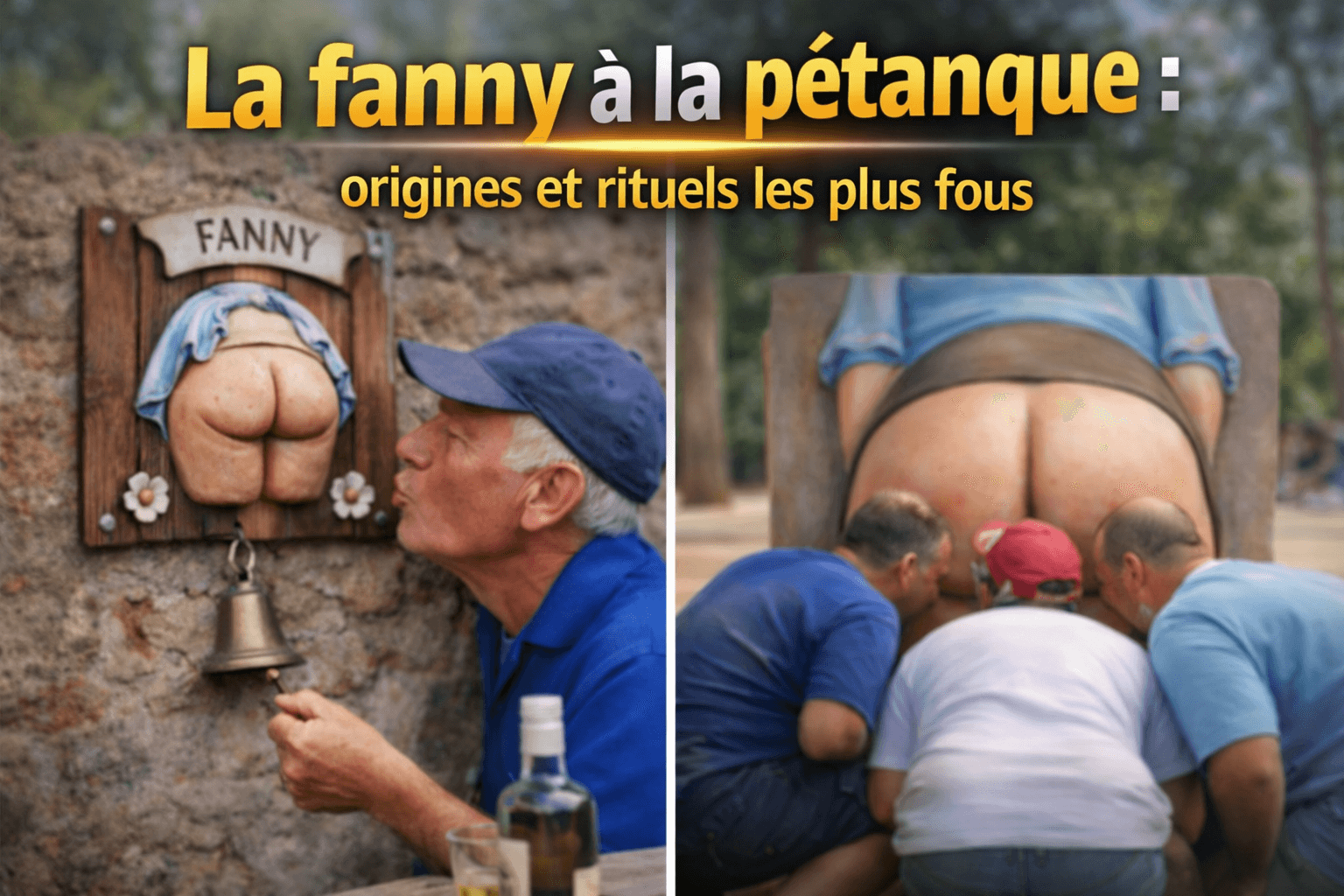
🏺 THE OFFICIAL LEGEND Fanny from Grenoble — the café waitress The most widespread version places the story in a Grenoble café at the start of the 20th century. A young waitress named Fanny would have, by tradition or mockery, offered her cheek to be kissed by players who lost 13-0. The cheek in question — and this is where versions diverge — was not always the one on her face. In some variants of the legend, it was a painting representing Fanny's buttocks that adorned the café wall, and it was this painting that the losers had to kiss.What is certain: the practice existed in cafés and indoor boulodromes in the Rhône-Alpes region before spreading throughout the South of France, then across the whole territory over the decades. Early 20th century Birth of the tradition in Grenoble cafés Local practice linked to the culture of indoor café-boulodromes in the region. The public shame of losing without scoring a single point is formalized by a ritual of gentle humiliation — and very much photographed. 1930s–1950s Spread throughout the South of France The tradition spreads with the development of pétanque as a popular sport. Each region adopts the ritual and adds its local variants. The painting representing Fanny — painted or sculpted buttocks — becomes an essential object in clubs. 1970s–1980s The Fanny becomes a collector's item Representations of Fanny multiply: paintings, sculptures, cut wooden plaques, painted ceramics... Flea-market dealers start selling these objects. Some clubs commission personalized versions. The tradition becomes institutionalized. Today Intangible heritage of French pétanque The Fanny is today recognized as a major cultural tradition of pétanque. Clubs that don't have their painting or their ritual are the exception. Regional variants are a source of local pride. And every generation of players knows at least one first Fanny that marked them for life. 🎙️ Paquita on the legend of Fanny "I did my research. There are at least seven different versions of who Fanny was. In one, she's a waitress from Grenoble. In another, a café owner from Lyon. In a third, a character invented from scratch by a player in 1923 to humiliate his brother-in-law. The truth is, nobody really knows. And frankly, it's better that way. A legend with an official origin loses half its magic. Fanny is more interesting mysterious." — Paquita, amateur and accidental historian
Myths vs reality: what we think we know (and what's false)
Over the decades, the Fanny has accumulated a thick layer of false beliefs, invented rules, and local traditions elevated to universal law. Let's untangle the true from the false.
❌ MYTH "The Fanny is an official FFPJP rule." "You must offer a drink." "The Fanny also applies in doubles and one-on-one." "Taking a Fanny disqualifies you from the rest of the competition." "Fanny was a real waitress whose surname is known." "It is forbidden to refuse the ritual in an affiliated club." ✓ REALITY The Fanny is a cultural tradition — no FIPJP or FFPJP rule mentions it. The drink is a local custom. Some clubs don't practice it, others demand a full round. In the classic tradition, the Fanny concerns triples. Its application in doubles varies by club. The Fanny has no official sporting consequence — it is purely a cultural ritual. Fanny's real identity remains unconfirmed. The archives of the presumed Grenoble café confirmed nothing. The ritual is a tradition, not a legal obligation. A refusal can however create a lasting chill with the club.What the "rule" says — and what it doesn't say
📋 THE CONSENSUS DEFINITION A team takes a Fanny when it loses a game without having scored any point — meaning the final score is 13-0 (or in some game variants, any X-0 score where the losing team never led). The traditional ritual requires that the losers kiss Fanny's buttocks — represented by a painting, a sculpture or any object standing in for them — and offer a drink or a round to the winning team, the referees or all the players present, depending on the local tradition. 13-0 the classic scoreof the Fanny 0 points scored
by the team that takes it ∞ ritual variants
cataloged in France 1 minimum drink
(depending on the clubs) 🍷 The drink — mandatory or not?
In the classic tradition, the team that takes the Fanny offers a round for everyone — or at least a drink to the winners. In large competitions with many simultaneous games, this rule is often relaxed (a drink to the opposing team only) for obvious practical reasons. In clubs, the tradition is maintained more strictly. The unwritten rule: whoever refuses the drink will be called out by the whole club at their next Fanny — and they will inevitably take one, one day or another.
The craziest rituals — a tour of France's traditions
France is a country of 67 million inhabitants and as many different ways of making someone take a Fanny. Here is a selection of the most creative, most humiliating, and most inexplicable variants cataloged across clubs.
📍 Classic South-East The mandatory Fanny Painting The loser kisses the painted buttocks on the painting hung on the club wall. The kiss must be audible, visible and owned. No pursed-lips kiss — the club secretary checks. A round for everyone bought by the losers. 🟢 Classic 📍 Lyon region The shame song In addition to the kiss on the painting, the losers must sing together a nursery rhyme dedicated to Fanny composed by the club. The lyrics change from club to club but systematically include the losers' first names. Musical quality is not required — enthusiasm is. 🟠 Intense 📍 Inland Provence The public procession The losing team stands up, lines up in front of the other players in the competition and recites out loud: "We took Fanny. We're proud of it. Well, no." Then everyone kisses the painting in turn, with their first name announced by the improvised presenter. 🟠 Public 📍 Occitania The selfie with Fanny Modern and documented version: the losers photograph themselves kissing the Fanny. The photo is sent immediately to the club's WhatsApp group. It stays pinned until the club's next Fanny. One loser tried to delete the photo. He was banned from the group. 🟠 Digital 📍 Périgord The Fanny in rosé The ritual is simple and dreaded: the losers offer a bottle of local rosé per player on the winning team. In triples, that makes six bottles. In the grand final of an 80-person competition, some teams calculated that a Fanny could cost more than the entry fee. 🔴 Costly 📍 Brittany (yes, there is pétanque in Brittany) The Fanny in cider Local adaptation of the southern ritual: the rosé is replaced with brut cider. The Fanny painting has been replaced by an oak wood sculpture representing a mermaid in an equivocal position. Kissing it in Brittany means kissing a hybrid and magnificent cultural heritage. 🟢 Local 📍 Paris — indoor boulodromes The urban Fanny In some Parisian clubs, the traditional painting has been replaced by a screen displaying the 13-0 score with the losers' names for 10 minutes. No kiss. No mandatory drink. Just digital shame, sober and cold. Parisians have their own style of humiliation. 🟢 Modern 📍 Var — unidentified club The Fanny in Bermuda shorts The loser must retrieve the Fanny painting, carry it under their arm to the refreshment stand, order the drinks while holding it visibly, and put it back in place. One hand on the painting, one hand serving. Nobody has questioned the origin of this rule. It dates from 1987 and that's how it is. 🔴 Legendary 📍 Unknown — reported on Facebook The Fanny speech The losing team's captain must improvise a speech of at least 2 minutes explaining why they lost 13-0, without ever using the words "bad luck", "terrain", "sun", "wind" or "it's not fair". Record duration: 12 minutes. Minimum accepted duration: 58 seconds. 🔴 Creative 📸Physical representations of Fanny — paintings, sculptures, plaques — are sold in many specialized pétanque shops and at flea markets. They range from the classic painted wooden model to the more recent resin model. Some clubs have theirs customized with the club logo. The smallest Fanny cataloged measures 8 cm. The largest, in a Var club, measures 1m20 and weighs 12 kilos.
The shame ranking — the worst ways to take a Fanny
Not all Fannys are equal. There's the ordinary Fanny — sad but dignified. And there are the legendary Fannys people still talk about ten years later. Here is the unofficial ranking of the most aggravating circumstances.
🏅 The Fanny in a competition final Losing 13-0 in the final, in front of 80 players waiting to go drink. The shame is proportional to the number of witnesses. Estimated psychological recovery time: 3 to 6 months. MAX SHAME 🥈 The Fanny against beginners You've been playing for 15 years. They've been playing for 3 weeks. Final score: 13-0 for them. Some players sold their boules after that. Others just changed clubs. BITTER 🥉 The Fanny against your own family Uncle Roger and his sons won 13-0. Your father is on the team that took the Fanny. The next Christmas dinner was awkward. Uncle Roger brought it up over drinks. LASTING 4 The Fanny photographed and shared The kiss on the painting was immortalized. The photo has been in the WhatsApp group since 2019. It resurfaces every anniversary of the date. It was printed and displayed in the club. ETERNAL 5 The Fanny on the day of your first competition You signed up with enthusiasm. You lost 13-0 in your first game. You had to kiss Fanny before you even understood what Fanny was. Welcome to the sport. FORMATIVE 6 The double Fanny (twice in the same competition) Statistically near-impossible. Humanly traumatic. A player from Toulouse lived it in 2018. He still plays. We respect him for it. LEGENDARYCan you avoid the Fanny?
The question every player silently asks themselves deep down. The short answer: yes, technically. The long answer: if you play long enough, no.
🧠 THE SACRIFICIAL POINTER STRATEGY "In some clubs, there's a theory that you can 'buy a point' by deliberately sacrificing a hopeless mène to score at least 1. Even 1 point is enough. It doesn't change the defeat — 13-1 is still humiliating — but it avoids the Fanny. This strategy is ethically disputed but universally understood by every player who has seen it practiced." 😤 THE STATISTICAL TRUTH "Every regular player will take a Fanny in their life. The question isn't if, but when. The numbers are relentless: if you play 50 games a year for 10 years, the probability of avoiding a 13-0 500 times is close to zero. The Fanny isn't a curse — it's just statistics with a buttocks painting and a round of drinks." 🎭 THE PHILOSOPHICAL APPROACH "The greatest players say you should kiss Fanny with elegance — even with pride. Because taking a Fanny means you played. It means you took part. And it means you had the bad luck or an opponent good enough to never let you score. There's something almost poetic about it. Well, that's what you tell yourself after the third drink." 🍑 Paquita's tip to survive your FannyWhen it happens — and it will — be the player who owns it with humor. Kiss the painting with enthusiasm, offer the drink graciously, tell the anecdote yourself before others do. A player who laughs at their Fanny before anyone else is a player who earns respect. A player who disappears to the toilets right at ritual time is a player remembered for the wrong reasons.
📖 PAQUITA'S BOOK To never take a Fanny againThe best way to avoid the Fanny? Improve. Paquita's book gathers 100 numbered exercises, level-based programs and the complete method to become a formidable shooter — with, as a bonus, the satisfaction of no longer being the team at 0.
📦 Order on AmazonFAQ — Your frequent questions
Is the Fanny compulsory in official competitions? + No. The FIPJP and FFPJP regulations do not mention the Fanny. It is a cultural tradition, not an official sporting rule. In major national or international competitions, the ritual is generally not practiced — or only in a symbolic way. It is in local clubs, friendly competitions and neighborhood doubles that the tradition is best maintained. Each competition organizer can decide whether or not to apply it in their specific regulations. Can we take a Fanny one-on-one or only as a triplet? + In the classic tradition, Fanny applies to all game formulas — triplet, doublette and tête-à-tête. A 13-0 head-to-head score is sometimes even considered more humiliating because you are on your own. The doublet adds a particular dimension: you share the shame with a partner, which can either unite a team or generate lasting tensions depending on how each person experiences the event. What happens if the club doesn't have a Fanny painting? + Improvisation takes over — and this is often where the most creative local rituals are born. Without a board, clubs have used a printed photo, a whiteboard drawing, a symbolic object placed on the counter, or simply the glass rule without physical support. There are even clubs where the Fanny is taken by kissing the jersey of the opposing team folded in four. Tradition adapts to the means at hand. Can we refuse to kiss Fanny's painting? + Technically yes — no one can physically force you to do it. Socially, it's another matter. In most clubs, refusing the ritual is seen as a lack of fair play and humor which can last a long time in the collective memory. There are accepted alternatives: a categorical refusal accompanied by a general tour offered with good grace is generally accepted without rancor. The important thing is the spirit of tradition — humility in the face of defeat — not the kiss itself. Is there an equivalent of the Fanny in other sports? + Several sports have similar traditions of gentle humiliation for disastrous performances. In Canadian curling, some clubs practice equivalent rituals. In darts, memorable first attempts are the subject of club traditions. But the Fanny remains unique in its size physical (the kiss) and visual (the permanent representative object in the club), which gives it a material presence that no other sporting tradition has truly reproduced. That's why it endures — it has a physical medium that gives it a concrete reality in the club's space. 📎 Related articles Rules Complete FFPJP rulebook — the real official rules Regulations 2026 Regulations — what is really changing Competition Official pétanque competition calendar PétanqueLand All the pétanque news Video Refereeing videos — game situations explained Tools Free PetanqueLand tools© Pétanque by Paquita — petanqueland.fr ·
📖 Paquita's book on Amazon
This article is a cultural and humorous exploration of the Fanny tradition. Any resemblance to Fannys experienced by existing players is statistically inevitable.