Règlement FFPJP · 27 July 2026
These 5 official petanque rules almost nobody really knows
Cinq règles souvent mal comprises pour éviter les litiges : boules, temps de jeu, but nul, ordre de jeu et réclamation calme en concours.Les litiges de concours viennent rarement d'une règle inconnue de tous : ils naissent d'un détail négligé au mauvais moment. Identifier ses boules, attendre avant de jouer, compter les boules restantes, mesurer et demander l'arbitre sans s'énerver suffisent souvent à sauver une mène. Le bon réflexe n'est pas de réciter le règlement : c'est de savoir quoi vérifier avant de parler.
1.Une boule doit rester identifiable
En compétition, une boule n'est pas seulement « la vôtre » : elle doit être conforme et son marquage doit rester lisible. C'est essentiel lorsque l'on doit vérifier un modèle, distinguer une boule déplacée ou reconstituer une position. Une gravure effacée, une boule modifiée ou un jeu mélangé à celui d'un partenaire transforme vite une situation simple en discussion interminable.
Avant la première partie, prenez trente secondes pour regarder le poids gravé, la marque et les signes distinctifs utiles. Pendant une mène sensible, marquez aussi les positions que vous pourriez devoir replacer. Cela ne remplace pas une mesure, mais évite de dépendre de la mémoire de chacun.
Une marque posée calmement avant un déplacement possible protège les deux équipes. Elle ne donne pas raison : elle rend la vérification possible.
2.La minute de jeu n'est pas une option décorative
Le délai réglementaire de jeu commence lorsque le but ou la boule à jouer a été déterminé. Il ne sert pas à précipiter un joueur qui réfléchit : il empêche qu'une équipe casse volontairement le rythme, prolonge une discussion ou cherche à refroidir l'adversaire. En pratique, le contexte compte, notamment si une mesure ou une intervention est en cours.
Le bon comportement consiste à préparer sa décision pendant que la situation se clarifie, puis à jouer sans théâtre inutile. Si le rythme devient réellement problématique, ne répondez pas par une autre lenteur : signalez-le au responsable du jeu ou à l'arbitre.
3.Un but nul se décide avec les boules restantes
Le réflexe « on rejoue la mène » est parfois juste, mais il n'est pas automatique. Lorsque le but devient nul, la suite dépend notamment du nombre de boules encore à jouer par chaque équipe. C'est pourquoi ramasser les boules dans la précipitation est une erreur : on efface l'information qui permet de déterminer la bonne suite.
Figez d'abord la situation. Comptez les boules de chaque camp, annoncez ce que vous voyez et laissez l'arbitre trancher s'il y a désaccord. Cette méthode paraît lente, mais elle est plus rapide que dix minutes de débat après une décision improvisée.
| Useful response | What to avoid | Avoid |
|---|---|---|
| But déplacé ou nul | Count the boules remaining | Ramasser immédiatement |
| Point contesté | Mesurer avant de jouer | Décider « à l'œil » |
| Position sensible | La marquer avant l'incident | Rely on memories |
| Discussion bloquée | Call the referee calmly | Voter ou s'invectiver |
4.L'équipe qui ne tient pas le point doit jouer
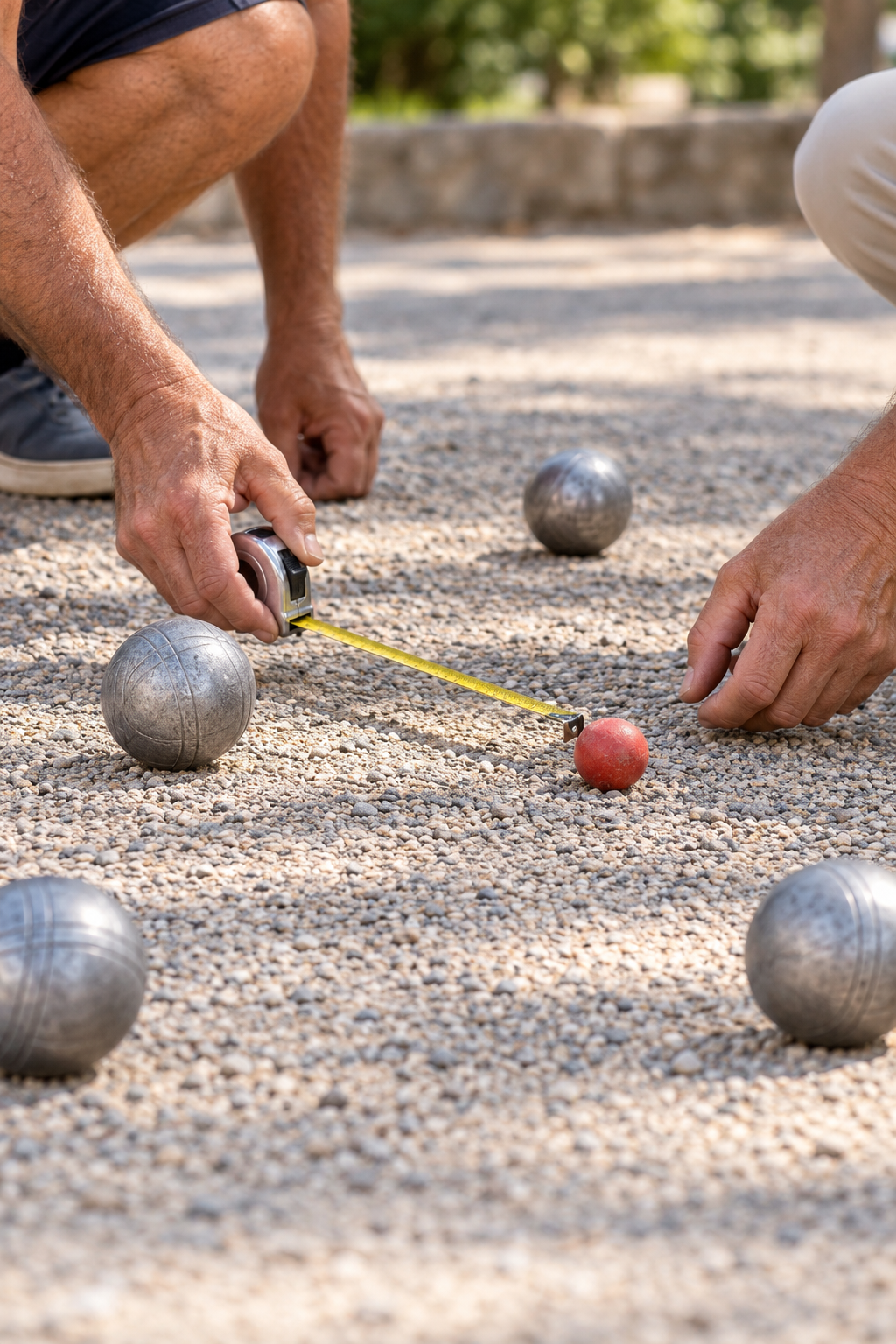
L'ordre de jeu ne dépend ni de l'habitude ni de l'équipe qui vient de lancer. L'équipe qui ne tient pas le point doit jouer. Si le point est incertain, on mesure avant de désigner le joueur suivant. Ce principe simple évite de donner une boule à l'adversaire, ou de jouer inutilement alors que l'on avait déjà l'avantage.
Sur un terrain irrégulier, une boule qui paraît devant peut être plus loin du but qu'elle ne le semble. La mesure est alors une décision tactique autant que réglementaire : elle confirme qui a la main et permet de choisir point, tir ou attente avec les bonnes informations.
Avant de dire « à vous », posez une seule question : qui tient le point, mesuré si nécessaire ? Cette phrase calme la mène et le partenaire.
5.Le règlement protège aussi l'attitude de jeu
Une réclamation est légitime lorsqu'elle porte sur un fait précis : position déplacée, mesure, ordre de jeu, délai ou application d'une règle. Elle devient contre-productive lorsqu'elle se transforme en procès d'intention. Les paroles, les déplacements gênants et les contestations répétées peuvent eux aussi appeler l'intervention de l'arbitre.
Formulez la demande sans accusation : « Nous souhaitons vérifier la distance » est plus utile que « Vous trichez ». Donnez à l'arbitre un fait observable, laissez-le décider et reprenez le jeu. Un joueur de club gagne en crédibilité lorsqu'il défend une règle sans chercher à gagner la discussion.
6.La routine de trois questions avant de réclamer
Quand une situation surprend, la première réaction est souvent émotionnelle. Remplacez-la par trois questions : qu'est-ce qui s'est passé exactement ? quelles boules restaient à jouer ? faut-il mesurer ou appeler l'arbitre ? Cette courte séquence sépare le fait de l'interprétation et évite les décisions irréversibles.
Pour aller plus loin, gardez le guide des règles de pétanque comme point d'entrée, puis travaillez les cas litigieux dans la rubrique arbitrage à la pétanque. En concours, votre objectif n'est pas de tout savoir par cœur : c'est de protéger le jeu, le rythme et l'équité.
Après une partie, choisissez une seule situation ambiguë et rejouez-la à froid : qui tient le point, quelles boules restent, quelle vérification manque ? Cette habitude crée de meilleurs réflexes que les débats d'après-match.
7.Questions fréquentes sur les règles méconnues
Faut-il toujours marquer les boules sur le terrain ?
Non, mais il faut le faire dès qu'une position peut devenir utile à vérifier : boule ou but susceptible d'être déplacé, mesure en cours ou obstacle proche. Une marque facilite un éventuel replacement.
La minute de jeu est-elle systématiquement sanctionnée ?
Le délai existe, mais son application tient compte de la situation. Une mesure ou une décision arbitrale suspend naturellement le jeu ; les lenteurs répétées et injustifiées, elles, peuvent être relevées.
Que faire si les deux équipes pensent tenir le point ?
On mesure avant la boule suivante. Si la mesure ne permet pas de conclure ou si un fait contesté l'empêche, l'arbitre est la bonne personne pour décider.
Peut-on contester calmement une décision ?
On peut demander une vérification ou une explication sur un fait précis. Une fois la décision prise par l'arbitre compétent, le jeu doit reprendre sans pression ni commentaire agressif.
Ces règles valent-elles aussi en partie amicale ?
Le cadre peut être assoupli d'un commun accord, mais les connaître améliore aussi les parties libres : moins de malentendus, plus de rythme et une meilleure préparation au concours.