Règlement FFPJP · 26 July 2026
Abandoned game rule in pétanque: what do the official regulations say?
Game abandoned in pétanque: forfeit, stoppage, score, referee's decision and regulatory consequences in official competition.1.What we really call an abandoned game
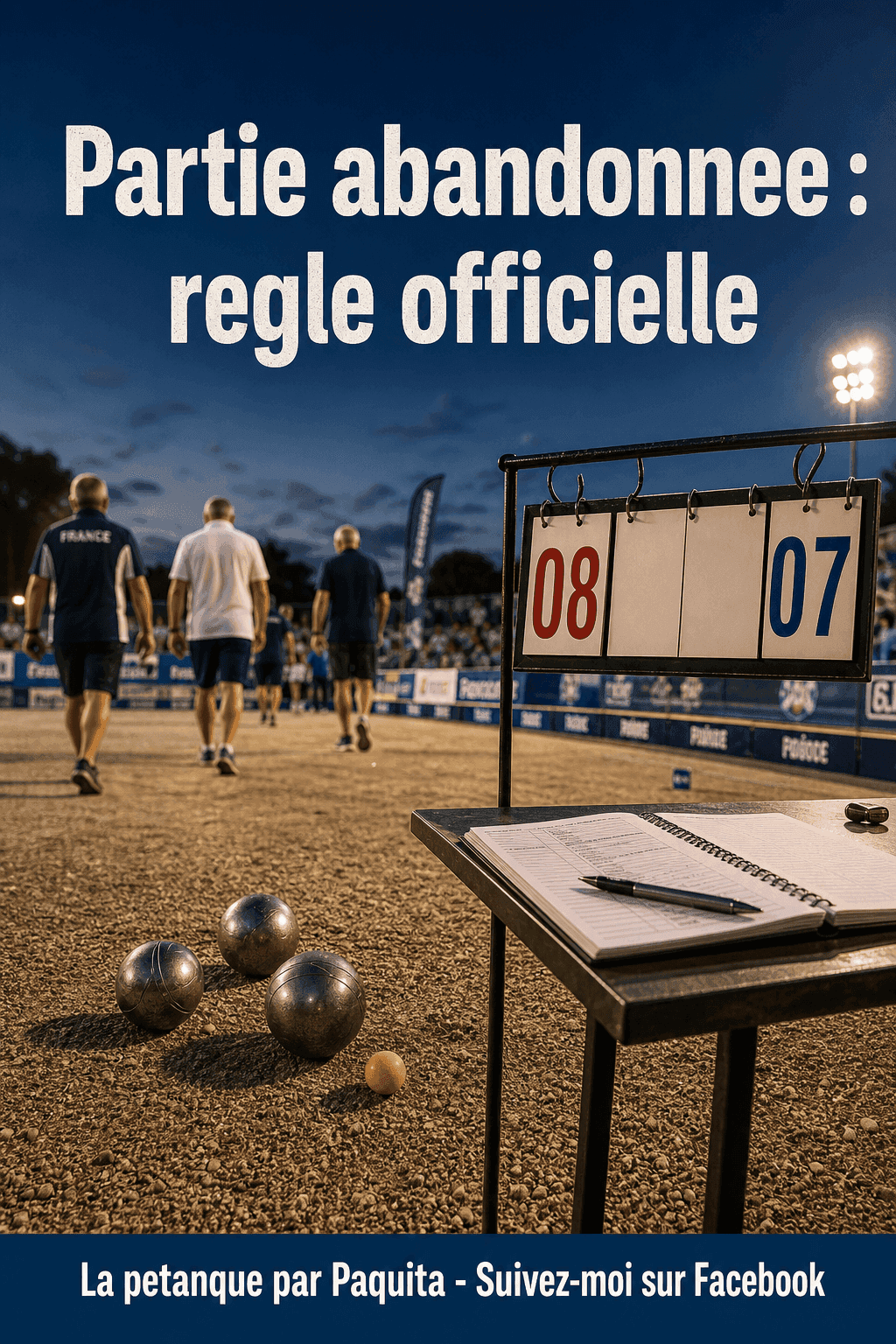
An abandoned game is a game started which does not come to an end because a team or a player no longer continues the game. This can come from a voluntary decision, a physical impossibility or a refusal to respect a decision. The common point: the game does not end with the usual sporting score obtained ball after ball.
It must be distinguished from the pre-game package. If the team does not show up at the start, it is rather called a forfeit. If she starts and then stops playing, we enter the case of abandonment during the game.
Leaving the field without notifying the referee or the scorer's table is the worst option: the organization must know if the game is stopped, suspended or abandoned.
2.What score is retained
The score retained depends on the specific regulations of the competition and the decision of the organization. In many contests, the team that withdraws is declared the loser, and the opponent is qualified. For rankings, the score can be recorded according to the uses provided for by the table or by the regulations of the event.
The sporting principle remains simple: a team must not take advantage of a retirement. If she voluntarily stops playing, she loses the game and the opponent continues their journey.
| Situation | Probable decision | Consequence |
|---|---|---|
| Reported injury | Referee informed | Loss or shutdown depending on the case |
| Voluntary departure | Abandonment | Defeat |
| Dangerous weather | Suspension | Possible recovery |
| Refusal of decision | Fault | Possible penalty |
3.Injury or discomfort: the most delicate case
An injury may make pursuit impossible. In this case, the priority is the safety of the player. We warn the referee, we have the situation noted and the organization applies the rules of the event. Depending on the format, the team may not be able to replace the player and lose the game.
This case must be treated seriously and without easy suspicion. Pétanque remains a sport, often played in the heat, with long days. Feeling unwell or injured has nothing to do with losing your temper.
4.Why the referee should be called
The referee secures the decision. He notes if the team abandons, if the game must be suspended, or if an external incident justifies an interruption. Without him, the versions diverge: one will say that the game was over, the other that it had to resume.
The scorer's table also needs clear information. In a group competition, in direct elimination or in a championship, a poorly recorded withdrawal can distort the table and delay all subsequent games.
5.Refusal to resume after a decision
A player may disagree with a referee's decision. However, he cannot block the game indefinitely. If the referee has made a decision and requests a restart, refusing to play exposes the team to more serious consequences than a simple loss of lead.
In this case, the abandonment joins the unsportsmanlike behavior. The team no longer leaves just one game; she refuses the framework of competition. This is precisely what arbitration seeks to avoid.
Even if you are convinced that you are right, finish the game within the set framework. A structured complaint after the fact is better than a hot start that dooms your team.
6.What to do concretely
Never leave a game without warning. Call the referee, briefly explain the reason for the stoppage, wait for the decision and make sure the scorer's table knows the result. This procedure seems cumbersome, but it avoids arguments and protects the entire competition.
An abandoned game is not just a lost game. This is an organizational event. Well managed, one incident remains. Badly managed, it becomes a conflict.
When the game gets tense, knowing how to stay lucid avoids losing your temper and making decisions that you regret afterwards.
Discover