Actualités · 8 April 2026
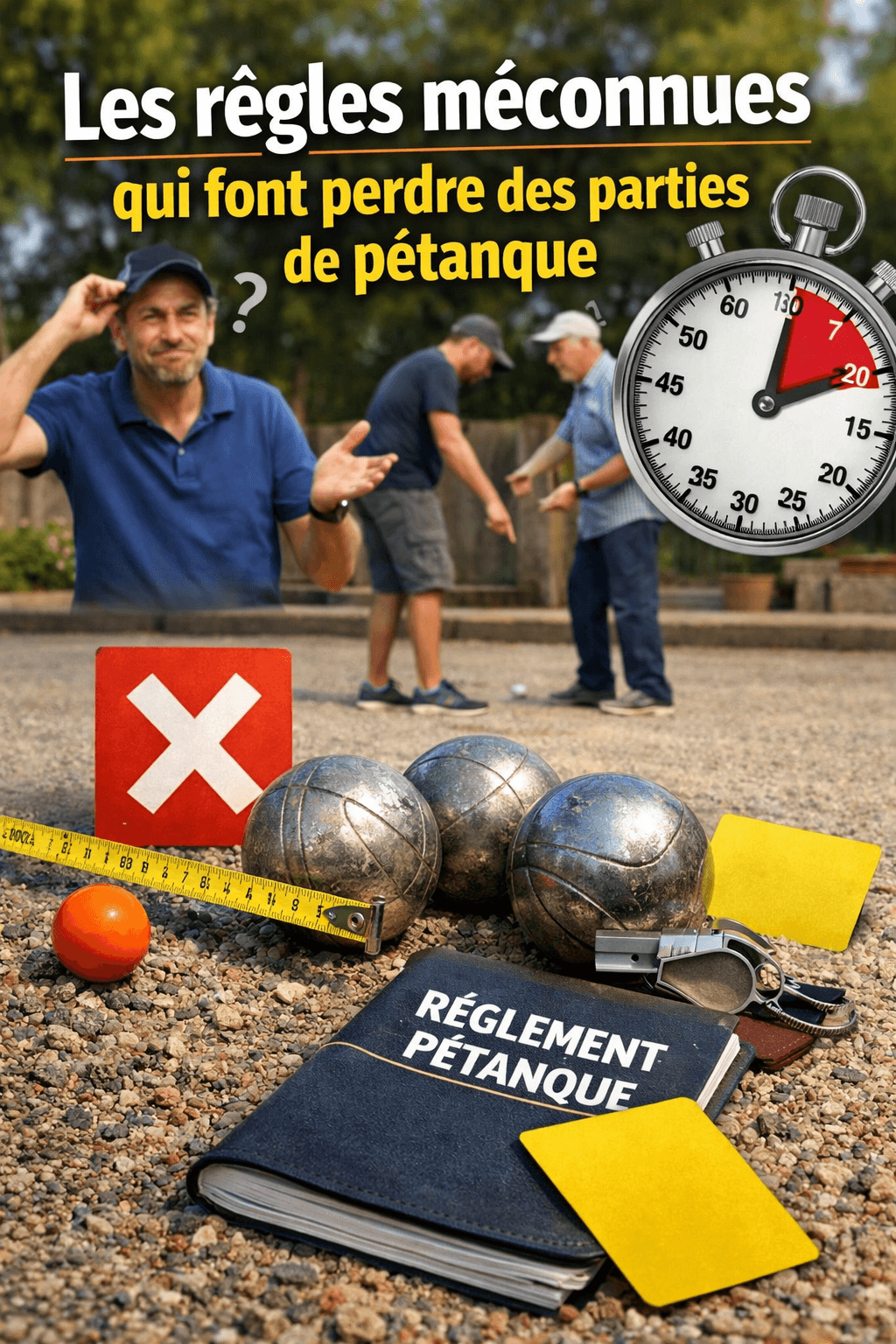
The little-known rules that lose pétanque games
Everyone knows the big rules: 13 points to win, feet in the circle, measure to know who is in front. But the FIPJP regulations also contain a series of provisions that most players have never read — and that they discover at the worst possible moment: in the middle of a competition, in front of a referee, with a game that is changing. These are not lawyer niceties. These are concrete, applicable rules that can change a score in seconds. 📋 Summary1 — The one-minute rule: what it says really
01 The one-minute rule — not 30 seconds, not "whenever you want" Very little known All ends Yellow card if not respected ❌ What players believe "We have 30 seconds to throw." Or again: "We have as much time as we need, it's a game of pétanque not tennis." ✓ What the rulebook says The player has a maximum of one minute from the moment it is their turn to play their boule. This time limit is official and punishable.The one-minute rule applies as soon as it is a player's turn to throw. The count starts when the previous team has finished playing, or when the umpire indicates it is your turn. A player who exceeds one minute without having thrown can be shown a yellow card — and repetition can go as far as a red card.
📍 Concrete example of a lost game Competition final. Team A discusses their strategy at length before each throw — deliberation visible from the sideline, timed. The umpire intervenes twice. On the third warning, yellow card for the captain. The destabilised team loses the next end. This rule exists to prevent deliberate game-slowing tactics. Consequence: Yellow card, then red card in the event of a repeat offence. The boule can also be declared dead if it is thrown after the time limit following the umpire's signal. See: The one-minute rule — full article2 — The jack going out of the playing area during an end
02 Jack out — the end is not necessarily cancelled Half known Marked terrains Impact on the score ❌ What players believe "If the jack goes off the terrain, the end is void and we start again." That is the answer the majority of players give. It is partially wrong. ✓ What the rulebook says If the jack goes off the marked terrain, the end is won by the team that has not yet played all its boules — or shared in certain configurations. It is not automatically void.The full rule distinguishes several situations: if both teams still have boules in hand, the end is cancelled and replayed. If only one team still has boules, that team scores as many points as it has boules remaining in hand. If neither team has any boules, the end is cancelled.
📍 Concrete example of a lost game Team A has played all its boules. Team B still has 2 boules. A shooter from Team A knocks the jack out with their last boule. According to the rulebook: Team B — which still has 2 boules — scores 2 points. Team A thought they had cancelled the end. They have just handed 2 points to the opposition. Consequence: The team that knocks the jack out having played all its boules gives points to the opposition if they still have any left. A shooter who "plays to knock the target out" must check how many boules the opposition still has in hand.3 — Boule played from the wrong circle
03 Wrong circle — the boule is dead, the point can be lost Little known Multiple terrains Boule cancelled ❌ What players believe "If I threw from the wrong circle by mistake, we just put the boule back and I replay." Nobody reports it, nobody penalises it, we carry on. ✓ What the rulebook says A boule played from a circle that does not match the one designated for the end is a dead boule. It is removed from play and cannot be replayed. If it has moved any boules, they are put back to their original position. 📍 Concrete example On a terrain with several lanes side by side, a player picks the wrong circle and plays from the neighbouring lane. Their boule lands near the jack and moves the opposition's closest boule. The umpire notes the error: the boule is removed, the moved opposition boules are put back, and the player has lost a boule for that end. Consequence: Irretrievable loss of the boule for that end. If it was a decisive boule, the end can swing.4 — The jack hidden behind a boule
04 Masked jack — when the end can be lost by the team that is "protecting" Very little known Defensive strategy End lost possible ❌ What players believe "If the jack is hidden behind my boules, the opposition cannot shoot — that's a good strategy." And if the opposition says they cannot see the jack, that's their problem. ✓ What the rulebook says If the jack is masked and the opposition cannot see it from their throwing circle, the team playing can ask the umpire to move an opposition boule to make the jack visible — or the end can be declared void. 📍 Concrete example Team A has 3 boules clustered in front of the jack, hiding it completely. Team B has to play but cannot see the jack from the circle. They call the umpire. According to the rulebook: if the opposition genuinely cannot see the jack, Team A must remove a boule to make it visible, or the umpire rules on the situation. The "invisible jack" strategy backfires against the team that uses it. Consequence: The team that masks the jack can be forced to remove an advantageous boule, or lose the end if the jack cannot be made visible without substantially altering the situation.5 — The boule that touches an obstacle off the terrain
05 Boule off-terrain after bouncing off an obstacle — dead or alive? Often debated Unfenced terrains Dead boule ❌ What players believe "If the boule bounces off a tree or a wall and comes back onto the terrain, it is still valid — it came back on its own." ✓ What the rulebook says A boule that touches an obstacle located outside the playing area marked off (tree, wall, outer fence) is immediately dead on first contact — even if it then comes back onto the terrain. 📍 Concrete example A player's shot drifts slightly to the left, bounces off a tree trunk located outside the marked terrain, and comes back into the playing area, moving several boules. The boule is dead at the moment of contact with the tree — the boule movements caused by this dead boule are cancelled, the boules put back to their positions. Consequence: All alterations to the play caused by a dead boule are cancelled. The moved boules are put back in place.6 — Playing a teammate's boule by mistake
06 Wrong boule played — the end can be replayed in full Little known Similar boules End replayed ❌ What players believe "If I play my teammate's boule by mistake, we just put the boule back and I replay with mine. No penalty." ✓ What the rulebook says Playing a teammate's boule without the umpire's authorisation is an irregularity. If the game situation has changed, the umpire can decide to replay the end from the start. Tolerance depends on the umpires but the maximum penalty exists. 📍 Concrete example Two players have identical-looking boules. One plays their teammate's boule by mistake and realises the error after the boule has changed the situation. The opposition challenges it. The umpire — if they confirm the irregularity — can order the end to be replayed in full from the drawing of the jack. Consequence: End potentially replayed. Preventive solution: mark your boules with a distinctive mark (grooves, marking) to tell them apart from your teammates'.7 — The jack thrown outside the legal distances
07 Jack at 5m or at 11m — when the throw is invalid Often ignored Start of an end Jack removed ❌ What players believe "You throw the jack wherever you want between 6 and 10 metres, roughly. If it's a bit too short or too long, it's fine." ✓ What the rulebook says The jack must be thrown at a distance between 6 and 10 metres from the circle (except on special terrains). A jack outside these distances is invalid — the opposing team gets back the right to throw it. See: article on distances 📍 Concrete example Team A tries to place the jack very far away to favour its best long-distance pointer. The jack lands at 10.80 metres. The umpire measures: invalid. Team B takes the jack. They place it at 6.5 metres — an ideal distance for their close-range pointer. Team A has just shot itself in the foot. Consequence: If Team A misses the placement twice, it is Team B that positions it definitively. Knowing the exact distances is tactically essential.8 — The boule that touches the boundary of the terrain
08 Touching the rope or the line — dead or live boule? Debated in clubs Marked-out terrains Dead boule ❌ What players believe "If the boule touches the rope or the line but stays on the terrain, it's still good." Contact with the boundary is not a problem if the boule stays inside. ✓ What the rules say A boule that touches a rope, a board, a peg or any physical boundary marking out the terrain is considered out of play — even if it remains physically inside. Contact alone is enough. 📍 Concrete example A glancing shot deflects slightly and grazes the rope marking out the terrain. The boule stops 30 cm from the rope, clearly inside the terrain. It is dead. If it has moved boules on the way, those are put back in place. Consequence: Dead boule as soon as it makes contact with the physical boundary. No exception — even a graze is enough if the rope has moved or the contact is proven.9 — Order of play: who plays when?
09 Playing out of turn — the offending team's boule may be removed Known but poorly applied Fast ends Cancelled boule ❌ What players believe "If I play by mistake when it was the opponent's turn, you just report it and put the boule back. It happens, it's a human error." ✓ What the rules say The opposing team may choose to leave the boule played out of turn in its place, or to have it removed. It is their choice — not the offending team's. And this choice can be tactically decisive. 📍 Concrete example of a turnaround Team B plays out of turn — its boule lands very close to the jack, in a good position. Team A realises the error. It now has the choice: leave the opposing boule in place (it takes the point but it is now its turn to play) or remove it (it forces Team B to play again correctly). A captain who knows this rule can gain a major tactical advantage from it. Consequence: The opposing team — not the umpire, not the offending team — decides the fate of the boule played out of turn. This decision can change the course of the game.10 — The boule that returns to the terrain after being out of play
10 Boule gone out then returned — always dead Surprising Sloping terrains Definitively dead boule ❌ What players believe "The boule went out but it came back on its own onto the terrain by rolling down the slope — it came back within the limits, so it's good." ✓ What the rules say A boule that leaves the playing area — even for a fraction of a second — is definitively dead. Returning to the terrain does not "resurrect" it. It is removed from play, and if it has moved boules after returning, those moves are cancelled. 📍 Concrete example On a slightly sloping terrain, a boule crosses the boundary, rolls on the outside gravel for 20 cm, then naturally returns to the terrain by rolling down the slope. It stops 5 cm from the jack. It is dead. If it has touched other boules while returning, those boules are put back to their position before the dead boule returned. Consequence: Immediate and definitive death as soon as the boule crosses the physical boundary of the terrain, whatever the rest of its trajectory.🎯 Quiz — Do you really know the rules?
Test your knowledge of the 10 rules in this article. Click the answer you think is correct.
⚡ PÉTANQUE RULES QUIZ — 5 QUESTIONS Q1 — Team A has played all its boules. Team B still has 2 boules. A shot from Team A knocks the jack off the terrain. What happens? The end is cancelled, we start again. Team B scores 2 points (as many points as unplayed boules). The end is counted normally, the jack comes back into play. ✓ Correct answer: B. When only one team still has boules in hand and the jack goes out, that team scores as many points as it has boules still unplayed. The team that has played everything gives away points if it knocks the jack out. Q2 — My team plays out of turn by mistake and our boule ends up in an excellent position. The opponent can: Compulsorily have our boule removed. Nothing — the boule stays and it is their turn to play. Choose to leave our boule in place or to have it removed. ✓ Correct answer: C. The non-offending team chooses — leave the boule or remove it. It is a tactical choice that belongs entirely to them. A good captain exploits this rule. Q3 — What is the maximum time allowed to play a boule once it is your turn? 1 minute. 30 seconds. 2 minutes. ✓ Correct answer: A. The official rule is 1 minute — not 30 seconds (a frequent misconception). It is the one-minute rule, official and punishable. Q4 — My boule grazes the rope marking out the terrain but stops clearly inside. It is: Valid — it is on the terrain. Dead — contact with the boundary is enough. To be decided by the umpire according to the extent of the contact. ✓ Correct answer: B. Contact with the physical boundary (rope, board, peg) is enough to declare the boule dead — even if it stays inside the terrain. Q5 — My boule leaves the terrain, rolls on the outside gravel, then comes back into the playing area because of the slope. It is: Valid — it came back naturally. To be assessed depending on whether it touched anything outside. Dead — any exit from the terrain is definitive, return or not. ✓ Correct answer: C. As soon as a boule crosses the boundaries of the terrain, it is dead — definitively. Any eventual return changes nothing.Summary table of the 10 rules
| Rule | Classic mistake | Reality | Impact |
|---|---|---|---|
| 1 — The one-minute rule | We think we have 30 seconds or "as long as it takes" | Exactly 1 minute, punishable | Yellow card |
| 2 — Jack knocked out | We think the end is always void | Points to the opponents if they still have boules | Points given away |
| 3 — Wrong circle | We think we just replay | Dead boule, irretrievable | Boule lost |
| 4 — Hidden jack | We think it is good protection | The opponent can request a boule to be moved | Boule removed |
| 5 — Obstacle off the terrain | We think the returned boule is good | Dead on first contact off the terrain | Dead boule |
| 6 — Wrong boule | We think we put it back and carry on | End potentially replayed | End cancelled |
| 7 — Jack out of distance | We think "roughly" is enough | The opponent regains the right to place it | Advantage lost |
| 8 — Boundary contact | We think "on the terrain" = valid | Dead as soon as physical contact is made | Dead boule |
| 9 — Out of turn | We think we put it back and correct | The opponent chooses to keep or remove | Opponent's choice |
| 10 — Returned boule | We think the return "saves" it | Definitively dead from the moment it goes out | Dead boule |
These 10 rules represent only a fraction of the FIPJP rules. Reading the complete official rules takes less than an hour — and it transforms the way you play and react to disputed situations. Downloading it and going through it once a season is probably the most worthwhile time investment you can make for your game. See: Complete FFPJP rules on PétanqueLand
📖 PAQUITA'S BOOK Mastering the game — technique and rulesKnowing the rules means no longer suffering the surprises. Mastering your technique means not needing the disputed situations. Paquita's book covers both — 100 exercises, the complete biomechanics and competition tactics.
📦 Order on AmazonFAQ — Your frequent questions
Do these rules also apply during friendly games between friends? + Technically, the FIPJP regulations apply to any game of pétanque – friendly or official. In practice, friendly parties often settle disputed situations amicably. But knowing these rules is useful even in friendly games: it allows you to resolve disagreements with a solid argument rather than an endless discussion. And that avoids unpleasant surprises during a first official competition where the same situations arise with a referee who applies the regulations to the letter. How can you challenge a referee's decision if you know the rule and he doesn't? + The correct approach is to calmly ask the referee the number of the article of the regulations on which he bases his decision. If you have the regulations available (on smartphone or printed), you can tell them the article that contradicts their decision. The referee is sovereign in his decisions on the field, but he can correct himself if he recognizes an error of interpretation. If there is a continuing disagreement, you can ask to speak to the contest's chief referee — not to the opponent, not publicly, but through official channels. What never works: shouting, arguing loudly, or threatening. What sometimes works: be calm, precise, and quote the text. Is the one-minute rule really applied in clubs? + In club competitions with inactive referees, it is rarely applied to the letter — which creates dangerous habits. In regional and national competitions with trained referees, it can be applied from the first notable excess. The main consequence of not knowing this rule: players who take 3 to 5 minutes per ball in regional competitions and who receive a yellow card "without having done anything wrong" — because they did not know that the limit was one minute. See our full article: The one-minute rule. Are there any other important little-known rules that you haven't mentioned? + Yes — this article doesn't cover everything. Some other rules which are regularly debated: the validity of the throw of the goal (precise criteria for it to be valid), the rule of the jack being replaced following its destruction, the exact conditions in which marks on the ground are authorized or not, the rule of balls not played in the event of a team abandoning, and the situations of a ball being touched by a moving player or spectator. The FIPJP regulations are several dozen pages long — complex situations are all covered there. See: Validity of the jack throw and Ground marks. 📎 Related articles Rules Complete FFPJP rulebook 2026 Rules The one-minute rule — complete article Regulations Validity of the jack throw — the exact rules Rules Playing distances 2026 — jack and boules Rules Ground marks — what is allowed Video Umpiring videos — game situations with commentary© Pétanque by Paquita — petanqueland.fr ·
📖 Paquita's book on Amazon
Rules based on the official FIPJP rules. Some interpretations may vary according to the umpires and the leagues. In the event of a dispute, the umpire appointed for the competition is sovereign in his on-terrain decision.