Règlement FFPJP · 27 July 2026
The 10 most common questions about official petanque rules
Jack distances, playing time, out-of-bounds boules, measuring and referees: clear answers to frequent petanque rules questions.1.Questions 1 and 2: goal distance and circle
The goal must be thrown at a valid distance depending on the category, with a classic mark of six to ten meters for seniors. It must also be visible and respect the boundaries of the land. If the roll is not valid, the reroll procedure applies according to the framework of the game.
The circle should allow the player to throw without biting or coming out before the ball hits the ground. Many mistakes come from a foot leaving the circle too early.
Good control before the first ball: distance, visibility, limits and foot position.
2.Questions 3 and 4: ball out of bounds and goal drawn
A ball out of bounds is void and no longer counts in the lead. A draw requires more attention, because the consequences depend on the balls remaining to be played. This is one of the points that causes the most bad applications in clubs.
Before picking up, count the remaining balls. This detail determines if the end is replayed, if a team scores or if the continuation must be managed differently.
| Situation | Good reflex | Mistake to avoid |
|---|---|---|
| Disputed distance | Measure | Make a decision by eye |
| Limit goal | Check validity | Replay too quickly |
| Order of play | Identify the point | Play out of habit |
3.Questions 5 and 6: measurement and equality
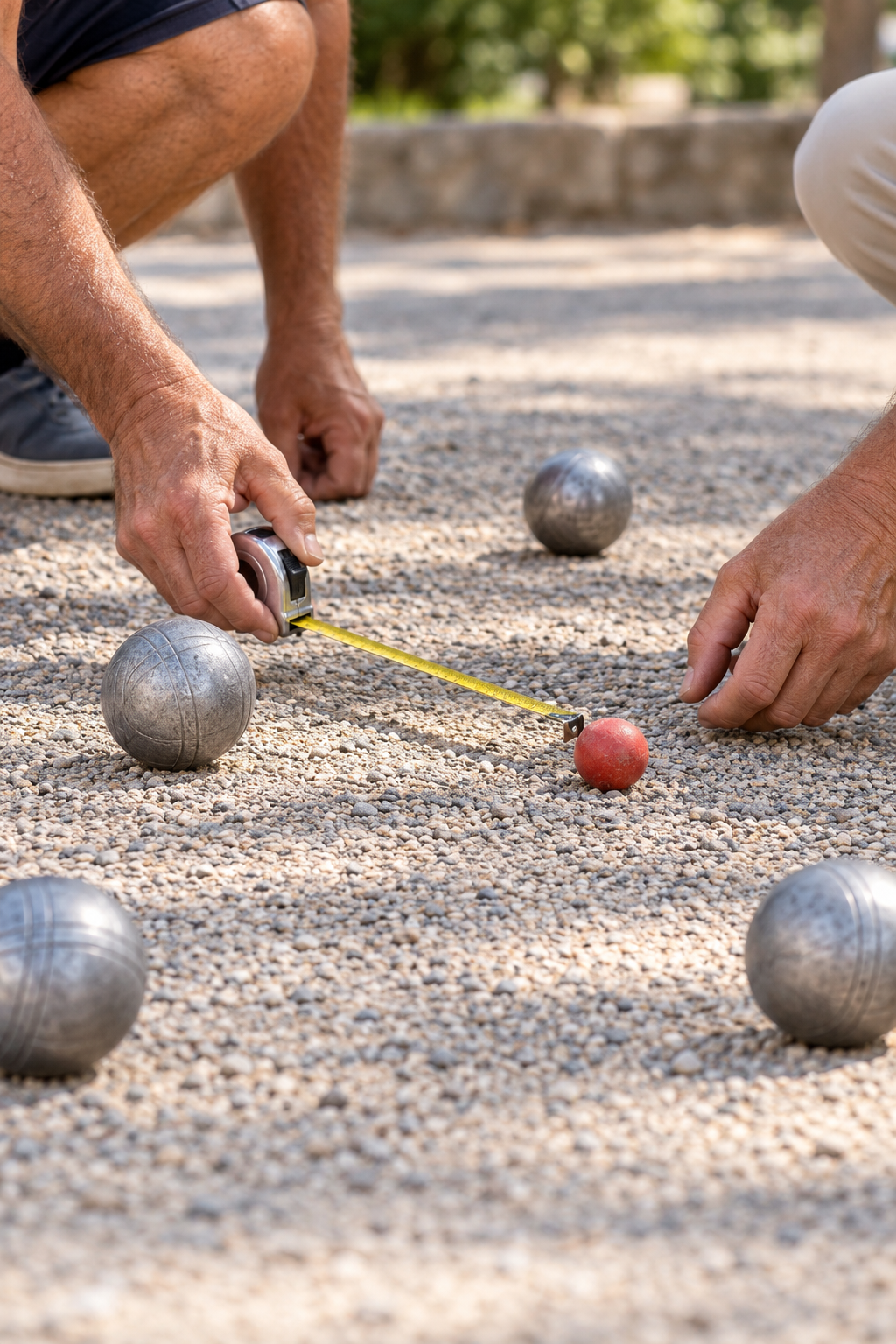
When the point is doubtful, we measure. If one team contests the measurement of the other, the referee may be called. In the event of a real tie, the order of play depends on the context: do both teams still have balls? does only one team have them? is the lead finished?
The most common error is to confuse visual equality and measured equality. A difference of a few millimeters is enough.
4.Questions 7 and 8: playing time and order of play
Play time is not vague advice. It serves to avoid excessive waits and voluntary slowdowns. The order of play belongs to the team which does not hold the point. If no one knows who is holding, we measure before continuing.
These two rules have the same objective: to keep a game fluid and fair. They prevent a team from gaining an advantage through confusion or slowness.
When the lead becomes fuzzy, come back to three questions: who is holding? how many balls are left? should we measure?
5.Questions 9 and 10: referee and behavior
Calling a referee is not reserved for major championships. In official competition, it is the right recourse when a situation can no longer be resolved calmly. Behavior also counts: speaking during the throw, endlessly contesting or refusing a decision can be punished.
Compliance with the regulations does not take away from conviviality. On the contrary, it avoids unnecessary arguments and allows everyone to play within the same framework.
6.The mental sheet to keep in competition
To avoid getting lost, keep a very short mental sheet. Before the throw: circle and goal. During the conduct: order, time, measurement. In the event of a problem: we stop, we check, we call the referee if necessary. After the decision: we resume the game without constantly returning to the incident.
This routine does not replace reading the rules completely, but it covers the vast majority of competition situations. Above all, it has one advantage: it forces players to talk about facts, not impressions. A distance is measured, a ball out is noted, an order of play is deduced from the point. When everyone accepts this framework, the game remains sporting.
In clubs, this sheet can be displayed near the scorers' table or transmitted to new licensees. It avoids improvised explanations and gives beginners the right reflexes from their first competition. The rules then become a game tool, not just a text that comes out when the dispute is already established.
For experienced players, the interest is different: this routine protects concentration. Instead of getting annoyed by an opposing interpretation, we follow a simple procedure and save our energy for the next ball. It is often in these details that close games are won, especially when fatigue makes each decision more fragile.
To manage registrations, pools, tables and results without improvising, the PetanqueLand software provides a clear framework for competition organizers.
Discover