Règlement FFPJP · 3 August 2026
Non-compliant attire in competition: checks, warnings and possible consequences
Tenue non conforme à la pétanque : comprendre le contrôle, corriger sans conflit et préparer son équipe selon les consignes de l’épreuve.A clothing issue is not solved by a showdown or by improvisation. Before a competition, check the notice, identify the precise issue and seek an immediate compliant solution. The relevant standard is the one announced for the event and the officials’ decisions.
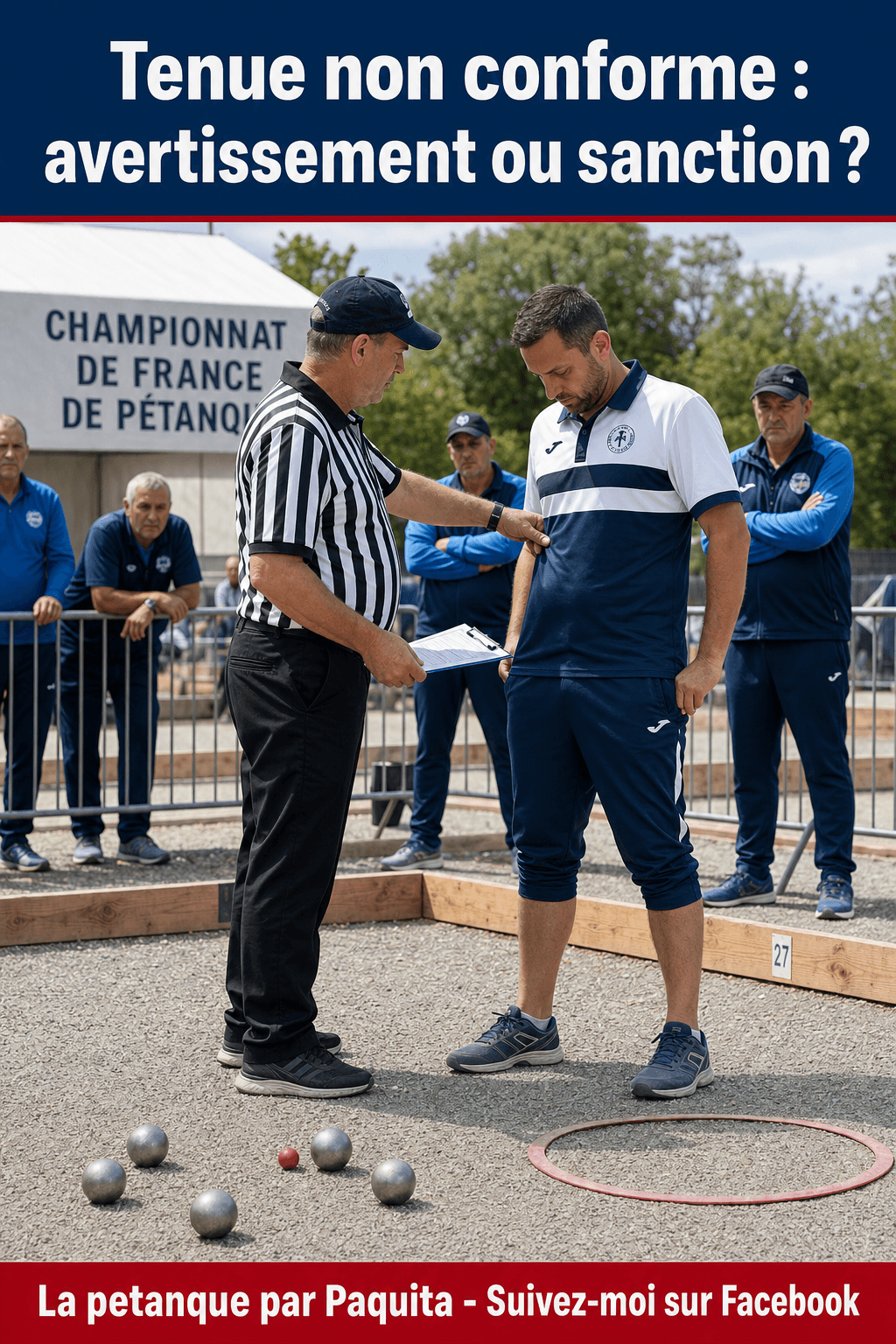
1.In pétanque, a clothing remark may concern a team shirt, expected presentation, an obviously unsuitable item or a specific rule announced for a championship. The essential point is not to guess a universal rule: find the event’s
written framework , its notice and, where applicable, its supplementary rules.Requirements are not read in the same way at a club event, a departmental competition or a championship. A practice tolerated the previous week is not an entitlement. Use the instruction applicable on that day, together with federation rules and the official’s decision within their role.
On-court marker
A check must stay precise and verifiable
2.A well-run check identifies the item concerned and when it was observed. Is it the shirt, team uniformity, a visible marking or an item contrary to the announcement? This precision protects players and organisers alike: it keeps a technical exchange from turning into an argument of opinions.
Before play starts, correcting the issue is usually the smoothest route. During the event, the captain may calmly ask which instruction applies and what timeframe or solution is expected. The answer depends on the facts, the event rules and the competent authority; it must not be invented at the side of the court.
Observed situation
| Useful response | What to avoid | Doubt before roll call |
|---|---|---|
| Reread the notice and ask for confirmation | Wait for the first end | Fixable item |
| Offer spare clothing or a change | Turn the check into a conflict | Instruction disputed |
| Ask for the text and note the contact | Assign motives to the official | Decision maintained |
| Follow the event procedure | Refuse to play without a clear process | Correct first, discuss later if needed |
3.The best way out of a clothing incident is rarely dramatic: a spare shirt, a plain jacket, an item removed or the organiser’s quick agreement. This does not mean that a player “admits a serious fault”; it mainly avoids wasting time, energy and concentration on something that could have been settled before the draw.
If the team considers the request uncertain, it can ask for a factual explanation. It helps to separate two moments: comply with the operational decision so the event is not blocked, then use the available clarification or complaint route if disagreement remains. Calm
precision is more useful than a demand shouted in front of opponents. Common mistake
When the issue can become more serious
4.Irregular clothing does not automatically have the same consequence everywhere. What makes a situation more serious is a clear instruction being ignored, an inability or refusal to correct it, or conduct that disrupts the event. Conversely, a good-faith error reported early and fixed quickly leaves room for a proportionate response.
Do not promise a specific penalty without the competition text in front of you. Officials assess the circumstances under the applicable rules. For major events, prepare clothing as carefully as licences, boules and timing: it is
part of preparation , not a decorative detail.The captain’s role: one voice, one method
5.At a check, the captain is the main contact. They hear the observation, ask for the exact reference, restate the possible solution and prevent three people answering at once. This discipline does not silence the team: it gives it a clear voice and keeps players available for the game.
One sentence is often enough: “We understand the point; here is what we can correct now. Can you confirm the instruction?” This tone opens a way forward. The captain can also discreetly ask the team not to comment on the decision to opponents or spectators.
The club routine that prevents most disputes
6.A club can prevent these situations by attaching clothing expectations to the notice, naming a contact and providing a few backup options. Players check the complete outfit the day before: top, bottom, footwear suited to conditions, rain or cold layer and required team item.
This routine is especially useful when several teams travel. One clear message sent early avoids competing interpretations. Organisers will find practical guidance in the
guide to organising a pétanque competition , while competitors can consultpétanque officiating resources officiating in pétanque.
Checklist before leaving home
Instruction reread
- : notice, supplementary rules and club messages. Team coordinated
- : everyone knows what is expected without guessing. Solution ready
- : a spare item is available. Captain identified
- : one person speaks for the team. To extend that preparation, also see the events and resources in
PetanqueLand’s competition section . The aim is not to “win” a check: it is to play in a clear, fair and calm framework.Frequently asked questions
Frequently asked questionsDoes non-compliant clothing always lead to exclusion?
No. The outcome depends on the applicable rule, when the check occurs, what can be corrected and how the situation is handled. Do not conclude before rereading the event documents.
Who can request compliance?
Depending on the organisation and event level, checks are handled by designated competent people, notably officials. The captain may request the precise instruction and expected solution.
Must you change immediately when a doubt is raised?
If a simple correction is possible, it generally prevents the incident getting worse. If there is disagreement, keep the useful information and use the stated process afterwards rather than blocking play.
Can an organiser set specific requirements?
An event may communicate its own instructions within its applicable framework. They should be known, consistent with federation rules and applied with the same care to every team.
What is the best team reflex?
Read the notice, prepare spare clothing and let the captain lead a factual exchange. This method protects playing time and the atmosphere of the competition.
Read the notice, prepare spare clothing and let the captain lead a factual exchange. This method protects playing time and the atmosphere of the competition.