Règlement FFPJP · 1 August 2026
Tenue de concours FFPJP : les règles utiles
Tenue de concours FFPJP : haut de club, bas, chaussures et contrôle. Les bons réflexes pour jouer sans litige inutile.Between club habits, federal requirements and referee decisions, correct attire remains a sensitive subject. Here's how to read the rule without exaggerating it. The objective of this article is simple: to separate the applicable rule, the tolerance of the field and the bad habits which create unnecessary arguments.
1.The correct outfit is not a cosmetic detail
In official competitions, the outfit is not only used to look pretty on the podium photo. It allows teams to be identified, clubs to be distinguished, a sporting image to be presented and disputes to be avoided when several teams are similar. This is why the FFPJP mainly supervises championships, nationals and competitions where the team represents a club, a committee or a selection.
The confusion comes from the fact that players often mix three frameworks: the free part on Sunday, the local competition with flexible application, and the championship where the requirements are much more formal. An outfit accepted in a small sector competition can therefore be discussed in a more strict federal test. The right question is not "have I ever played like that?", but "what are the special rules for today's event?"
Field reference. A holding decision is settled before the start of the games, with the referee or the table, never in the tension of a decisive match.
2.What is really obligatory
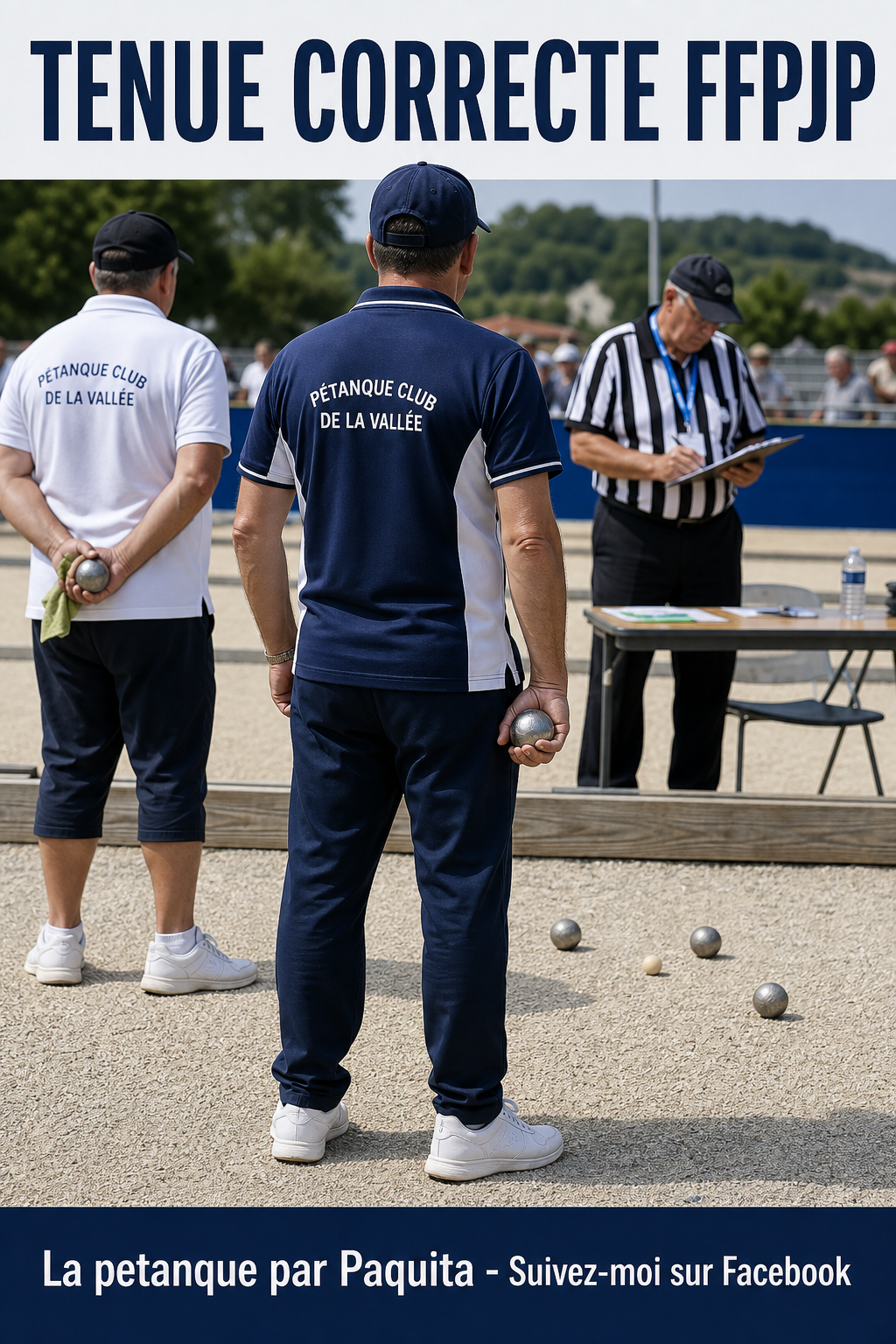
The first point to check is the top. When the event requires club attire or identical attire, players from the same team must wear a consistent, recognizable top that complies with the instructions announced. In the championship, this top can become obligatory from the start of the competition, not only on the square of honor.
The second point concerns the general presentation: clean clothing, suitable for sport, without shocking messages and without dangerous elements. The rules do not transform the referee into a fashion judge. Above all, he asks him to prevent a situation that would harm identification, the sporting image or security.
| Prepared player | Improvising player |
|---|---|
| quick check, short discussion | unnecessary litigation risk |
3.What is not automatically prohibited
Many discussions start with a sentence that is too simple: "jeans are prohibited", "shorts are prohibited", "caps are prohibited". In reality, the framework depends on the event, the category, the competition phase and the specific regulations disseminated by the organization. The right reflex is to read the poster, the invitation or the sporting regulations before concluding.
A different bottom between two partners does not always lead to immediate exclusion, especially if the test did not require complete uniform clothing. On the other hand, in a championship or a televised final phase, the requirement can be significantly stricter. The margin of tolerance is therefore not the same everywhere.
Risk of litigation depending on the timeBefore departure - 2/10The correction is simple, visible and accepted.During the painting - 7/10The same error can be perceived as a sporting challenge.
4.Outfit check: when should you react?
The control must be done before the actual launch of the games, as much as possible. A serious organizer announces the instructions at registration, reminds them when the teams are called and allows time to correct a reasonable oversight. Waiting until a team is leading 11-3 to challenge its outfit gives the impression of a sporting maneuver more than respect for the rules.
If there is any doubt, the captain must ask the referee for advice calmly, without calling out the opponent in front of everyone. The outfit is treated as an administrative point: facts, rules of the test, decision. Not as a pretext to destabilize.
| Situation | Good reflex | Mistake to avoid |
|---|---|---|
| Before registration | Read the test instructions | Rely on a club habit |
| At the control | Present clear evidence | Chat without documents |
| If there is any doubt | Call the referee calmly | Challenge the opponent |
| After correction | Keep track simple | Modify without notifying the table |
5.Warning, correction or sanction
In most cases, the goal is not to punish but to bring the team back into compliance. The referee can request a change of top, refuse a clearly unsuitable outfit or report to the organization a situation contrary to the instructions. The heavy sanction occurs especially if the team refuses to comply or if the regulations of the event have explicitly provided for it.
A prudent player always keeps a simple solution in his bag: club top, neutral jacket, suitable shoes and a change of clothing. This is not administrative superstition. This is a way of avoiding a competition being decided on a detail that could be anticipated.
Keep the proof simple and the workaround. In competitions, the calmest player is often the one who has anticipated the administrative details before arriving on the field.
6.The Paquita method before going to play
Before a competition, check four things: level of the event, requirement at the top, instructions at the bottom, and forecast weather. If you are playing as a team, decide on the outfit together before arriving on site. The worst scenario is to discover during the call that two players do not have the same height even though the championship requires it.
For clubs, the cleanest solution is to write the instructions in the registration message. A clear sentence avoids twenty discussions in the field. And if you organize regularly, PetanqueLand competition software helps keep useful information in one place, from registrations to game sheets.
PAQUITA TOOL — PetanqueLand competition and mêlée softwareWhen it comes to matters of dress, registration, and organization, the hardest part is keeping information clean. The PetanqueLand software helps clubs manage registrations, teams, groups and tables without hazardous copies. Understand pétanque officiating.
FAQ - Your frequently asked questions
Is the club top still mandatory?
No. It depends on the type of event and the specific regulations. It is much more often required in championships, in team competitions or in official phases.
Can we play in shorts in FFPJP competitions?
This depends on the test instructions. Sports shorts may be tolerated in certain competitions, but championships may require stricter presentation.
Can a referee change an outfit?
Yes, if he notices non-compliance with instructions or an image or security problem. The correction must remain proportionate and based on the applicable regulation.
Should we challenge an opponent's behavior during the game?
It is better to report doubts before the start or calmly ask the referee for advice. A late challenge often seems opportunistic.
What outfit should you prepare to avoid any problems?
A club top, simple sporty bottoms, closed shoes adapted to the terrain and a neutral jacket cover the vast majority of situations.