PetanqueLand
Search: Movie should be distinctly Please enter a search term in the search field.

Not to be missed

Search suggestions

Why do some boules veer off for no apparent reason? (Pétanque) Article Why do some boules veer off for no apparent reason in pétanque? PAQUITA ON PÉTANQUE STRIKE Video Pétanque: when you celebrate too soon… Video pourquoi il ne faut jamais celebrer avent la (1)-Couverture Boule diameter: why the wrong choice holds you back (Pétanque) Article Which boule diameter should you choose? The direct impact on your performance THE DIGESTION EXCUSE Video
Cart 0
EN▾
FrançaisEnglishEspañolItalianoDeutschPortuguêsNederlandsCatalàالعربية中文ไทย
PetanqueLand
  • Home
  • SHOP
    • Pétanque Book Shop
    • Pétanque Player Clothing
    • Pétanque Objects & Decor
    • Pétanque Gift Ideas
    • See all
  • ⭐ The Pétanque Software
  • Videos
  • 🏛️ OFFICIAL
    • Upcoming competitions
    • Results & calendar
    • Rules explained
  • FREE Zone
    • Free online software
    • Free tools
    • Lab
  • News by Paquita
Total articles: 193
FFPJP Regulations - Article 76

What the regulations say about behavior in competition

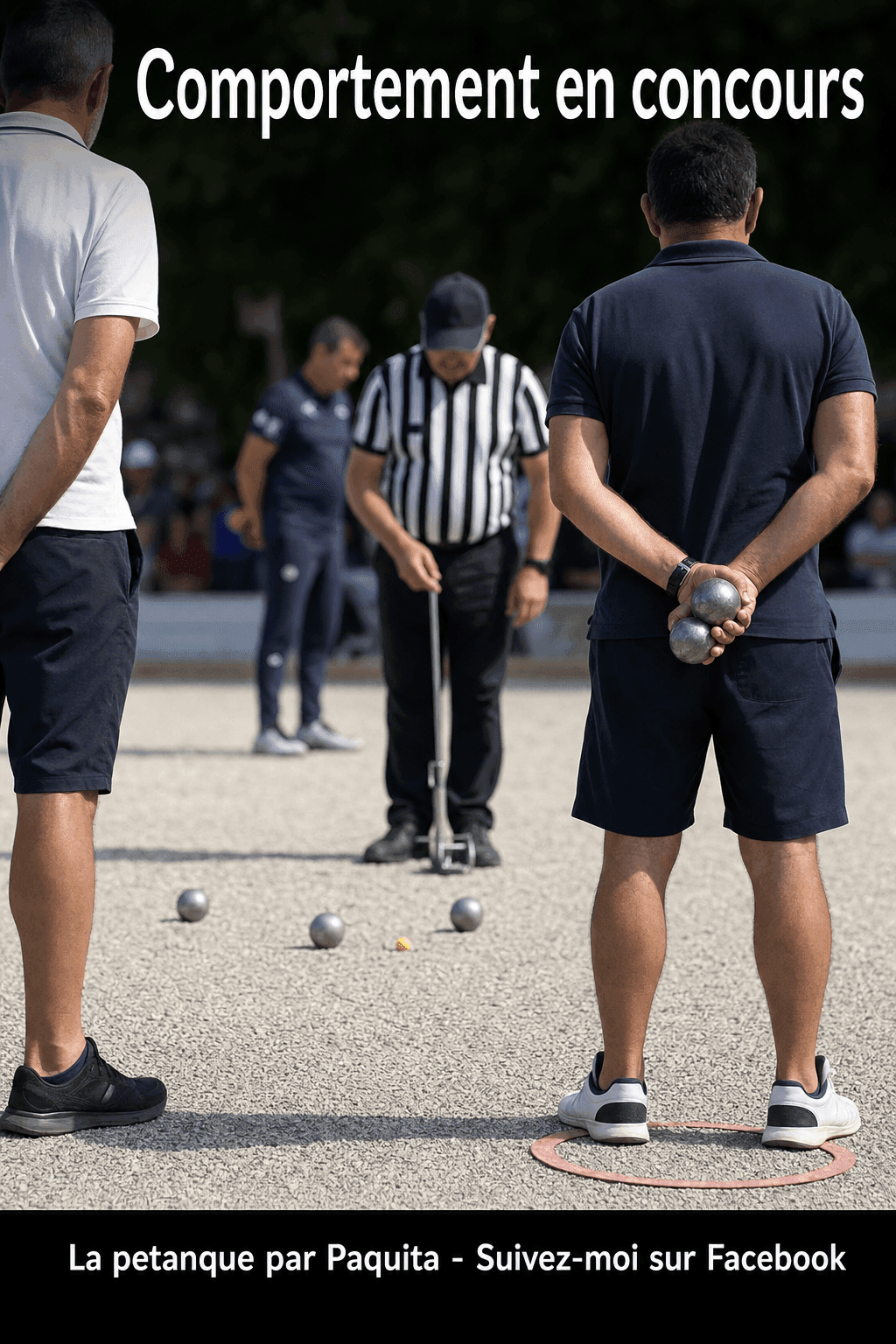
Petanque remains friendly, but an official competition imposes a precise attitude. Respecting your opponent is as much a part of the game as pointing or shooting.
Official rulesTournamentBy PaquitaReading: 8 mins
We talk a lot about distances, the circle and the jack. We sometimes forget that behavior can also change a game. In FFPJP competition, a player's attitude is not a question of personal style: it must allow everyone to play under normal conditions, without intimidation, without deliberate delay and without permanent dispute.
1
arbitrator
reference decision in the event of a dispute
0
pressure
no intimidation accepted
1 min
rhythm
the game must not be slowed down
13
points
respect is worth until the last ball
In this article
  1. Why behavior is part of the rules
  2. Respect the opponent during their playing time
  3. Discuss a decision without crossing the line
  4. What attitude should you adopt with the referee?
  5. The behaviors that create the most problems
  6. When can the behavior be sanctioned?
  7. The right behavioral routine for competitions
  8. FAQs

1.Why behavior is part of the rules

An official competition brings together teams who do not always know each other, sporting issues and sometimes a large audience. Without a behavioral framework, the game can become a succession of verbal pressure, ambiguous gestures and calculated delays. The rules exist so that the outcome depends on the game, not on intimidation.

Respecting expected behavior does not mean playing without passion. It is accepting that passion is expressed in the balls played, not in the disruption of the opponent.

2.Respect the opponent during their playing time

When the opponent is in the circle or preparing his shot, he must be able to concentrate. Comments, unnecessary movements, heavy laughter or gestures in a bad mood can be perceived as annoyance. Even if the intention is not always bad, the effect matters.

The correct reflex is simple: you position yourself correctly, you avoid crossing the visual trajectory and you let the player execute his shot. This discipline also benefits your team, because it creates a cleaner game.

!

To remember: behavior is not a decoration around the regulations. It conditions the fairness of the game, because a hindered opponent no longer plays under the same conditions.

3.Discuss a decision without crossing the line

Disputing is not prohibited when there is real doubt. What poses a problem is systematic, aggressive or directed protest against a person. A team can request a measure, call the referee or report an anomaly. She cannot turn every incident into a trial.

The tone used matters as much as the substance. A calm and precise sentence opens a check. An accusation closes the discussion and often pushes the referee to take control more firmly.

4.What attitude should you adopt with the referee?

The referee is called to decide when the players can no longer do so calmly. Once present, we give him the facts, we avoid unnecessary interpretations and we respect his decision. Discussing after the decision slows down the competition and undermines the authority necessary for the smooth running of the games.

An experienced player knows that the referee is not an additional opponent. It is there to maintain a common framework. The clearer you are, the quicker and more accurately he can intervene.

+
Paquita's advice

If a sentence does not help your team or clarify the game, save it for after the end. In competitions, well-placed silence is often better than a brilliant remark.

5.The behaviors that create the most problems

The most frequent disputes do not always come from a spectacular fault. They often arise from small, repeated behaviors: talking during the throw, making people wait for no reason, commenting on the opponent's balls, entering the field too quickly or refusing an obvious measure.

These gestures seem minor, but they change the atmosphere of the game. A team that experiences this climate can lose its concentration. The regulations therefore seek to protect the serenity of the game.

Controlled attitude versus contentious behavior
Regulatory reflex
clear and enforceable decision
Approximate reflex
dispute or loss of point
Disciplinary risk depending on attitude
Prepared player - 8/10
He announces, controls and accepts the decision without slowing down the game.
Imprecise player - 4/10
He improvises when the situation becomes sensitive.
SituationGood reflexCommon mistake
Tactical discussionshort and usefulpermanent comment
Disputesappeal to the refereepressure on opponent
Waitingnormal rhythmvoluntary delay
End of gameshake handsprovoke after the score

6.When can the behavior be sanctioned?

The sanction depends on the context, severity and repetition. A warning can be enough to reframe an attitude. A more serious or intentional fault may result in harsher measures, especially if it disrupts the competition or targets the referee.

The best way to never enter this zone is to accept a simple idea: you can be combative without being provocative. Great teams put pressure with their balls, not with their comments.

7.The right behavioral routine for competitions

Before the game, we greet. During the game, we let it play. In case of doubt, we calmly formulate the problem. After the decision, we resume the game. At the end, we recognize the result. This basic routine is also a mark of level.

It avoids unnecessary tensions and gives a serious image of your club. In a long competition, this consistency counts as much as technique, because it allows you to save energy for the real important balls.

PetanqueLand competition & melee software

For clubs, clear organization reduces expectations, misunderstandings and tensions around pitches and draws.

Discover
FAQ - Your frequently asked questions

Any comments or noise likely to interfere with concentration should be avoided. Team discussions should remain discreet and useful.
Yes if the doubt is real. The dispute must remain calm and may lead to an appeal by the referee.
Yes, if the behavior disrupts the game, slows down the contest or disrespects the players or officials.
Yes, as long as they do not serve to intimidate or disturb the opposing player during his gesture.
Remain calm, avoid overbidding and call the referee if the behavior really interferes with the game.
Related articles
RulesThe little-known rules of pétanqueToolsFree tools PetanqueLandOrganisationCompetition and melee software

© 2026 PetanqueLand - Petanque by Paquita. Educational article based on the spirit of the FFPJP regulations.

Share Follow

📬 Paquita's pétanque newsletter

New articles, videos, free tools and offers — straight to your inbox.

← Previous articleRule on discussions and disputes in pétanque competitionsNext article →Why and how to mark your boule at petanque: rule and official obligation
← Return to rules

About PétanqueLand

PétanqueLand.fr is the fun, practical site devoted to pétanque: videos, humour, photos & memes, free tools and news.

Find Pétanque by Paquita and join the community!

Categories

  • ⭐ Celebrities
  • 🎥 LIVE training
  • ❓ Questions & Tips
  • 🎭 Parodies
  • 🐕‍🦺 Animals
  • ⚖️ Refereeing
  • 🍻 Refreshment bar
  • 🎬 Series
  • 😂 Pétanque humour
  • 🤯 WTF moments
  • Most viewed
  • What's new

Information

  • Home
  • SHOP
    • Pétanque Book Shop
    • Pétanque Player Clothing
    • Pétanque Objects & Decor
    • Pétanque Gift Ideas
    • See all
  • ⭐ The Pétanque Software
  • Videos
  • 🏛️ OFFICIAL
    • Upcoming competitions
    • Results & calendar
    • Rules explained
  • FREE Zone
    • Free online software
    • Free tools
    • Lab
  • News by Paquita

Follow Paquita

Find Pétanque by Paquita on my social networks:

Facebook
TikTok
YouTube
Instagram
X

📸 Photos & memes
🎯 Pétanque videos
😂 Humour & WTF moments
🧰 Free tools

© 2026 PetanqueLand — The craziest boulodrome on the web. Pétanque videos, humour, refereeing & debates. Contact · Legal notice · Privacy Join me: Facebook · TikTok · YouTube · Instagram · X