Actualités · 4 August 2026
Why some pétanque players sabotage themselves
Une routine simple pour éviter l’auto-sabotage à la pétanque, mieux lire une mène tendue et aider l’équipe à choisir sans précipitation.In pétanque, self-sabotage does not come from one missed boule. It appears when urgency, commentary or the urge to make up for it replaces reading the end. A short routine restores a useful decision.
1.Self-sabotage starts before the throw
People often call it “cracking”, as though everything were decided at the moment of release. In reality, self-sabotage usually starts seconds earlier: a player wants to erase the previous boule, a partner calls for a shot without naming its purpose, or the team confuses speed with urgency. The action may be sound; the decision is already unclear.
A tense end requires putting the facts back in order. Where is the jack? Who holds the point? How many boules remain? What path does the ground genuinely offer? These questions do not take away anyone’s temperament. They give the player a precise task and stop emotion from deciding in their place.
A missed boule is information, not an identity. Before commenting on the throw, look at what the end still allows you to build.
2.Four habits that feed self-sabotage
The first habit is wanting revenge for the previous shot. The second is announcing a solution before observing the opponent’s boule and the slope. The third is talking for too long when one instruction would do. The fourth is playing to prove you can make the spectacular shot.
These habits have one thing in common: they shift attention to ego, the instant result or other people’s judgement. A steady player instead returns to one practical question: what must my boule protect or open up? That wording does not promise success, but it makes the decision shareable with the team.
The right choice is not always the cautious one. Shooting can be right when the target is clear, the gain is easy to read and the shooter is in rhythm. Pointing can be ambitious when it closes an area or forces the opponent to reveal their game. What matters is choosing the risk for the end, not to repair your image.
3.Read a tense end without telling yourself stories
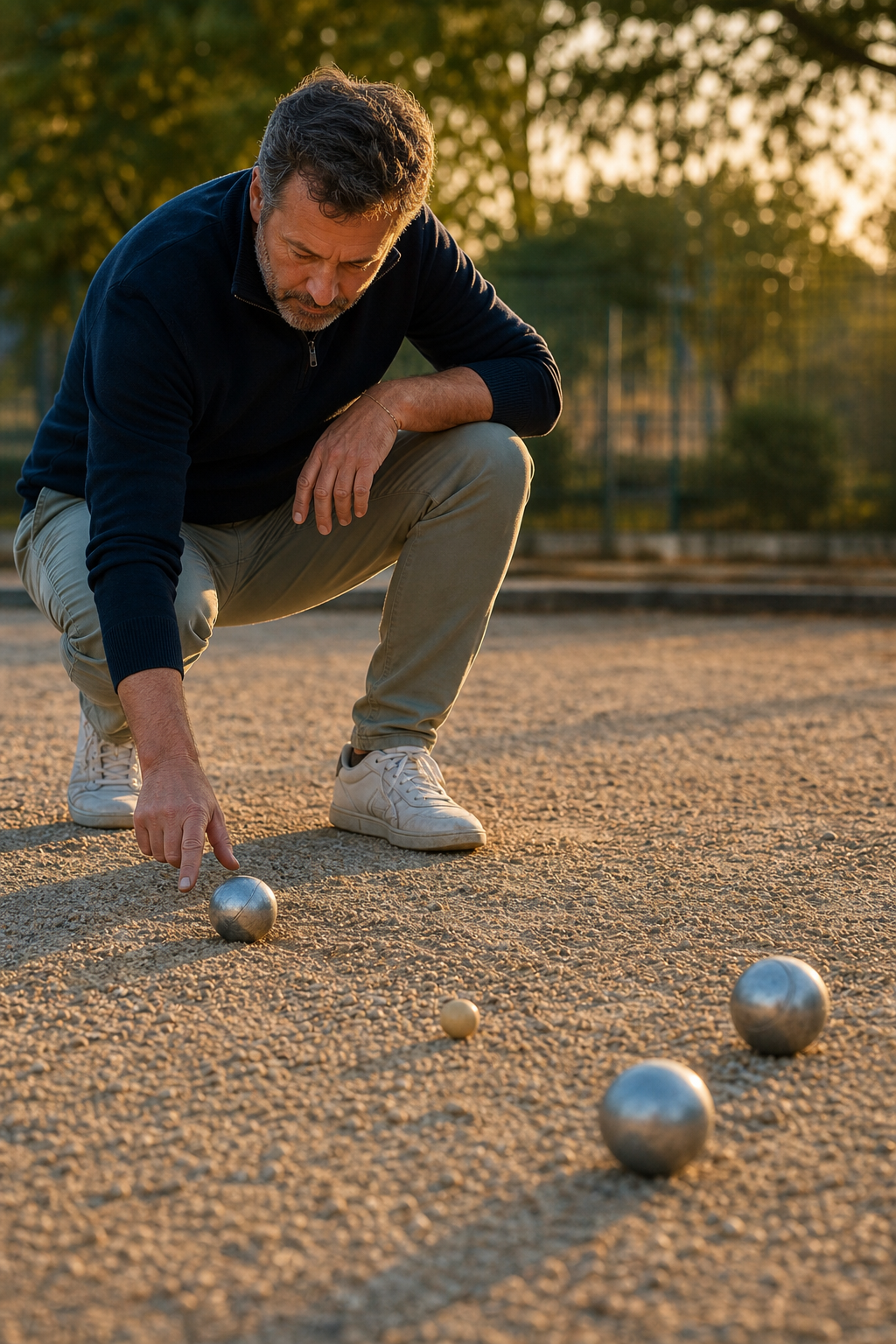
Pressure magnifies what you look at. If you see only the score, every boule becomes final. If you also read the remaining boules, obstacles and the jack’s position, several answers return. Take time to observe from the circle, then near the boule if the situation allows it.
| Observed sign | Useful question | Healthier decision |
|---|---|---|
| An opponent’s boule looks easy to shoot | Is the line really clear? | Compare the shot with a point that reduces its value. |
| Few boules remain | What must be protected now? | Name the objective before choosing the action. |
| The ground carries to the left | Where does the boule actually finish? | Choose the landing reference rather than aiming at the centre. |
| The score is close | Which mistake would cost the most? | Play a shot the whole team accepts. |
This reading also improves communication. Saying “shoot” contains neither intention nor limit. Saying “remove the boule blocking access without exposing the jack” gives direction. Even if the shot fails, the team knows what it tried to do and can resume the end without an instant trial.
4.Paquita’s fifteen-second routine
When the tempo speeds up, a routine is not there to make you cold. It creates a small space between emotion and action. Here is a sequence you can use in competition: look at the jack, count the boules, choose an area, take one breath, state an intention, then play.
One intention is enough. “I close the right”, “I keep a reply boule” or “I shoot the boule that blocks us” are short phrases. They avoid conflicting instructions and leave the player free to feel their throw.
After a miss, do not try to play faster. Find one controllable detail: a landing reference, a release area or the number of boules left.
The aim is not to erase pressure. Pressure tells you that the end matters. The work is not to obey it blindly: slow down just enough to become accurate again, then accept the result before preparing the next boule.
5.Repair team dialogue during the end
Words can either steady a team or lock a player in. “You always crack” turns a temporary difficulty into a label. “We have two boules left; let’s protect the right” brings everyone back to action. The difference seems modest; over a whole game, it changes the quality of decisions.
The pointer can name the landing reference, the middle player the troublesome boule and the shooter the target they see. Each person brings one short piece of information. The captain gathers what matters instead of multiplying opinions. A calm team does not talk less: it talks accurately.
Save technical analysis for the end of the end. While one boule remains, useful talk answers three needs: where to play, which risk to accept and what to keep. That discipline protects confidence as much as the score.
6.Train your reset instead of judging yourself
To work on this, create scenarios instead of only repeating shots. Put an opponent’s boule near the jack, give your team two boules and name an imaginary score. Before every throw, a partner must summarise the objective in fewer than eight words. After the end, note the forgotten reference and the phrase that helped.
This exercise teaches the difference between result and process. A good decision can produce a bad boule; a poor decision can sometimes succeed by chance. By discussing intention before success, the group turns an error into training material.
To go further, connect this routine with what makes pétanque champions calmer and the rare quality that helps great players stay available. Progress begins when the next end matters more than the previous boule.
Play five ends with one simple rule: before every boule, the team states its objective in no more than eight words.
Frequently asked questionsFrequently asked questions about self-sabotage in pétanque
Can you sabotage yourself even with good technique?
Yes. Technique does not protect you from a rushed decision, an unclear objective or a comment that breaks rhythm. A clear routine puts technique back in the service of the end.
Should you always play the safe point under pressure?
No. Shooting is still relevant when the target is clear and its benefit justifies the risk. The key is to compare the consequences of both options before playing.
What should you say to a partner after a missed boule?
Give one piece of information for the next boule: the number of boules, an area to protect or a shared objective. Analyse the throw after the end.
How can you avoid playing to make up for it?
Return to the facts: jack, remaining boules, ground and objective. This short list stops the urge to prove something and gives you a controllable action again.
How long does it take to build this habit?
A few regular practices are enough to make it familiar. The aim is not to suppress every emotion, but to regain a clear decision when pressure arrives.