Psychologie · 21 August 2026
Pourquoi certaines équipes de pétanque semblent lire dans les pensées
Les équipes qui paraissent télépathes partagent surtout une lecture du terrain, des mots simples et des décisions entraînées ensemble.Teams that seem to understand one another without speaking are not guessing: they have rehearsed the same readings, use simple words and know when to ask for an opinion before playing.
1.Telepathy is mainly shared memory
You watch them and wonder how they knew. The pointer has already chosen the area, the middle has moved their gaze to the troublesome boule and the shooter prepares their movement without a long discussion beginning. It is not a mysterious gift. It is a library of situations lived together : the same competitions, the same debriefs, the same mistakes explained rather than hidden.
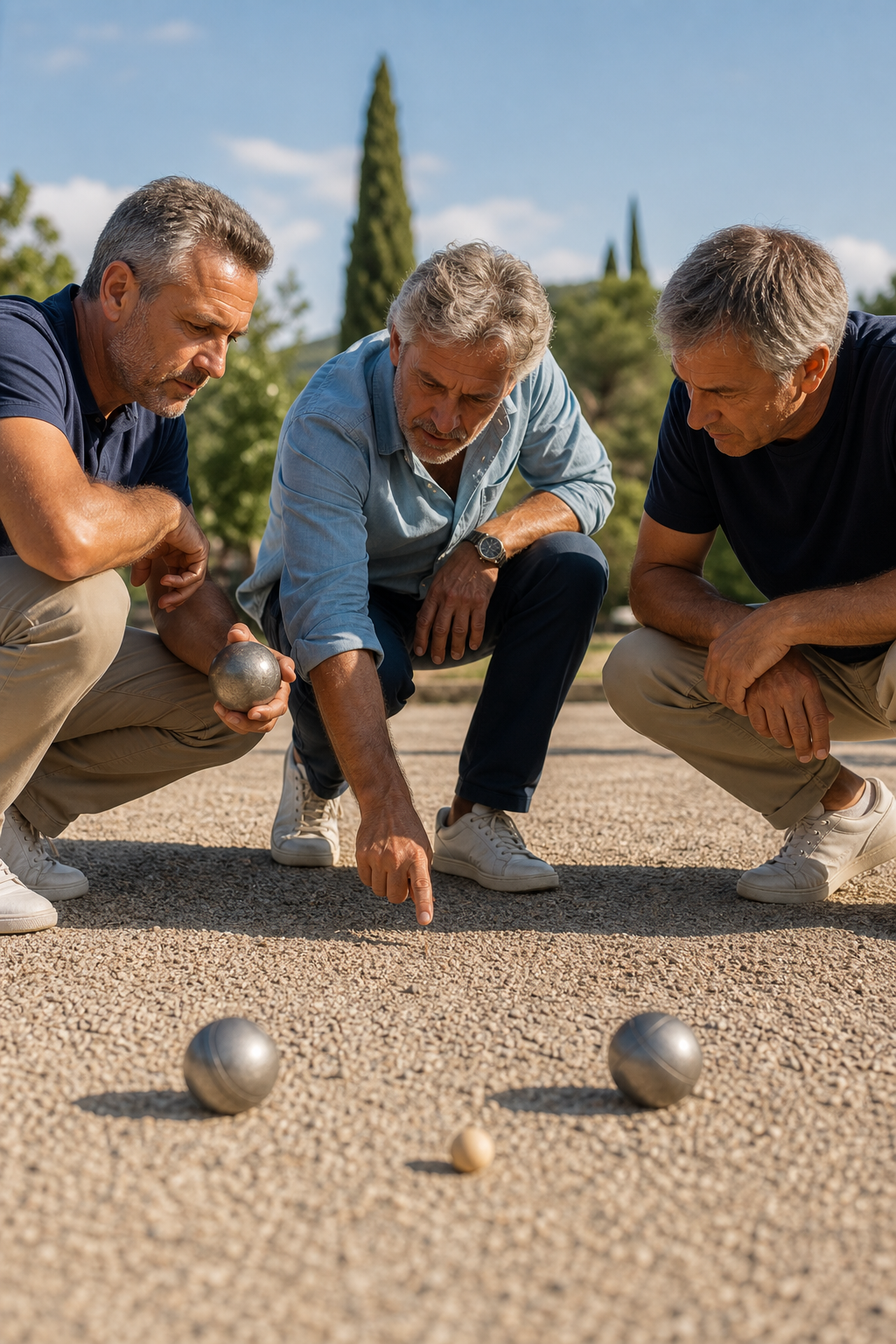
A good team quickly recognises what it has already seen. An opponent’s boule is tight to the jack; two boules remain on each side; the court slopes to the right. The three players do not necessarily imagine the same shot, but they first identify the same facts. That shared base keeps them from debating contradictory impressions.
Before suggesting a shot, state what you see: distance, slope, boules remaining, score. The option comes next.
2.Read the same end before looking for the same solution
The trap is to believe that good understanding demands instant agreement. On the contrary, a mature team accepts two options, then compares them. In an end at 10–10, the pointer may ask for a safety boule while the shooter sees a possible shot. Both lines of reasoning are useful if the group knows what risk it wants to take.
The score changes the value of a shot. At 3–1 early in the game, protecting the point can be smart. At 11–12, a clear opening can justify a more committed decision. The middle then plays a valuable role: they restate the objective, not to impose their voice, but to save the team time.
3.A short language is better than a long instruction
Effective words are few and always the same. “In front”, “tight”, “hold”, “open game”, “we take the point”: these expressions do not replace technique; they stop it being drowned out. Before using them in competition, define them in practice. Otherwise, everyone hears something different under pressure.
| Team expression | What it must mean | Control question |
|---|---|---|
| Safety point | A boule that limits risk | What does it protect? |
| Open game | An option that can turn the end around | What happens if it misses? |
| We hold | Do not offer an easy boule | Where is the forbidden area? |
Giving too much advice during the delivery. Once the decision is made, give the player the silence their movement needs.
4.Practise deciding, not only throwing
Useful practice is not limited to placing ten boules in the same spot. Set up a situation: score, number of boules remaining, a target and a given court. Everyone first says what they read, then the team chooses a shot. After the throw, discuss the decision before commenting on technical success.
This method quickly reveals misunderstandings. One player thinks “in front” means ten centimetres; another hears thirty. A pointer does not see the same slope as a shooter. Correcting these gaps in practice makes exchanges much smoother on Sunday. Find observation exercises in the Improve at pétanque.
5.Under pressure, protect the connection first
A team seems telepathic especially when it is behind. That is when the words shorten and a glance becomes valuable. After a missed shot, a partner does not repeat the mistake; they say what must be played now. After an overlong point, the team looks for the correction, not the culprit. Useful communication looks to the next boule.
Paquita recommends a simple rule: one voice at the moment of choice, then a clear sign of agreement. This framework protects the player in the circle and calms the rest of the team. To refine these choices, explore tactics, pointing and shooting. They are the same three languages, put to the service of an end.
Frequently asked questionsFrequently asked questions
Do you need to play together for a long time to understand each other well?
Time helps, but the quality of conversations and debriefs matters more than the number of competitions.
Must the middle always decide?
No. They facilitate the decision, but every role can offer a relevant reading of the court.
Can there be two different opinions?
Yes. What matters is choosing a shared objective before the throw, then supporting the player carrying it out.
How can you avoid contradictory instructions?
Define a few shared words and appoint one voice at the moment the decision is made.
Which Paquita advice should I remember?
The best chemistry is built boule after boule, in the details people take time to share.