Actualités · 12 March 2026
Why you should ban supermarket boules
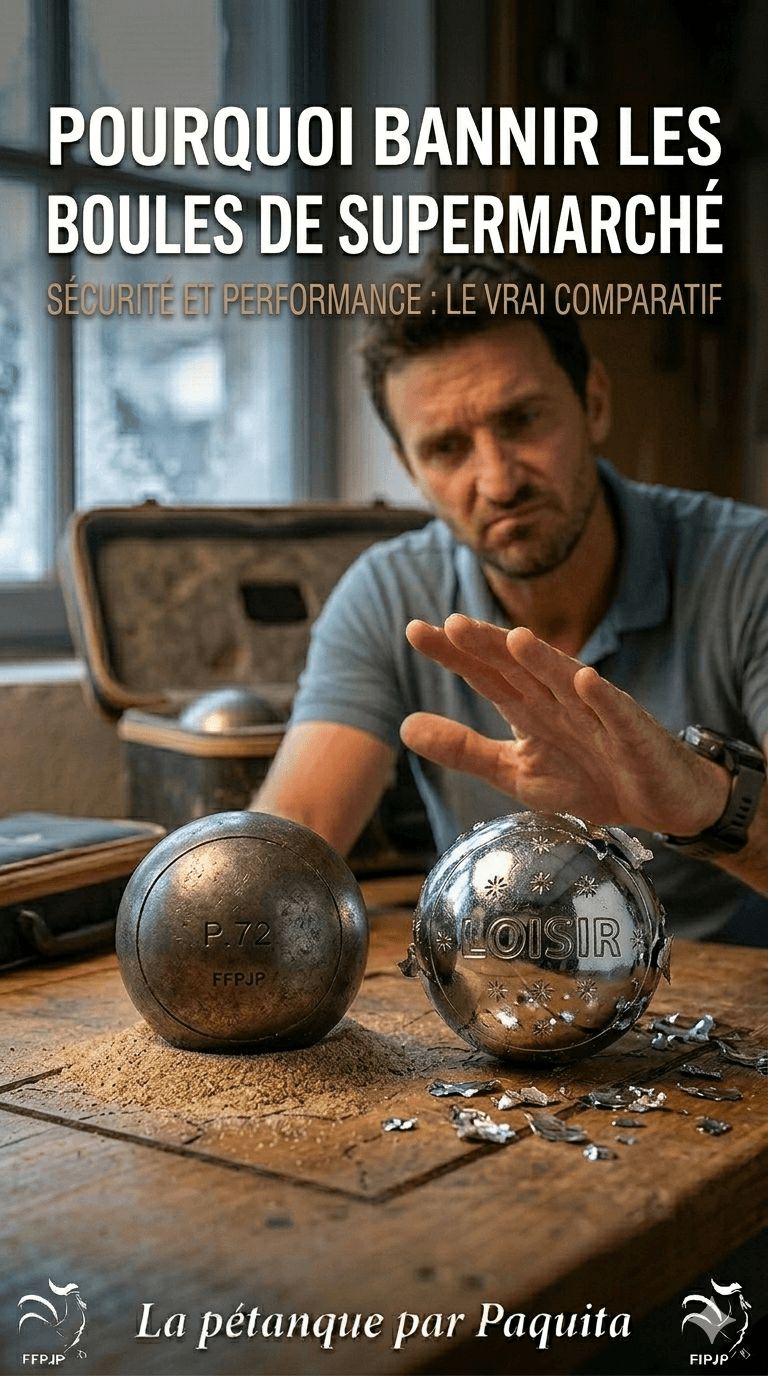
Non-compliant weight, soft steel, fanciful diameter, rust in three months... Paquita scans the boules sold in supermarkets and explains why they cost you more thanAutopsy of a supermarket boule
Paquita subjected a box of boules bought in a supermarket to the same checks that a FFPJP umpire would carry out at the entrance to a competition. Here are the results.
🔬 CHECK RESULTS — STANDARD SUPERMARKET BOULE Boule 1 weight 658g FIPJP standard: 650–800g ✓ Within the standard Boule 2 weight 640g FIPJP standard: 650–800g ✗ Out of standard (-10g) Boule 3 weight 653g FIPJP standard: 650–800g ✓ Low limit Boule 1 diameter 70.3mm FIPJP standard: 70.5–80mm ✗ Out of standard (-0.2mm) Sphericity ±0.6mm Acceptable tolerance: ±0.2mm ✗ Non-compliant Approval marking Absent Mandatory: FIPJP no. + weight + manufacturer ✗ Not approved Steel quality Soft / low Standard pétanque steel: 50+ HRC ⚠ Soft — marks on impact Rust at 3 months Present Standard indoor storage ✗ Oxidised surface 🎙️ Paquita on the autopsy "Two boules from the same box, bought at the same time, from the same manufacturer: an 18-gram difference. In the same game, you throw a boule at 658 grams then one at 640 grams. Your gesture is identical — but the trajectory is different, and the bounce is different. You will spend whole ends believing you have a technical problem. You just have an equipment problem." — Paquita, after testing in real conditionsThe 6 concrete problems on the court
⚖️ Problem 1 — Inconsistent weight between the boules The weight difference between the boules of the same supermarket triplet regularly reaches 15 to 25 grams. For a shooter, it is the equivalent of shooting with a different boule on every throw. Learning the gesture becomes impossible — you compensate constantly without knowing it. → Technical progress blocked from the start 📐 Problem 2 — Out-of-standard diameter and approximate sphericity A boule that is not perfectly round does not roll predictably. The sphericity of supermarket boules regularly exceeds the acceptable tolerance — it may measure 70.1 mm in one direction and 70.8 mm in another. Result: unpredictable trajectories that look like bad luck but are physics. → The court seems unfair. It is not: it is your boule. 💥 Problem 3 — Soft steel that marks and deforms The cheap steel used in supermarket boules is softer than the steel of approved boules. From the very first games, marks appear at every impact. These dents alter the surface and amplify the imprecise trajectories. A marked boule rolls differently from a smooth boule. → The boule degrades with every game instead of ageing normally 🟫 Problem 4 — Fast rust despite normal storage Low-grade steel has no effective surface protection. A game in light drizzle, a slightly damp court, or simply the ambient humidity of an unheated cupboard are enough to trigger the oxidation process. By the third month, the first red films appear. → Effective lifespan: 1 to 2 seasons at best 🚫 Problem 5 — Systematic refusal in official competitions No supermarket boule bears the FIPJP approval number mandatory to play in a FFPJP-approved competition. The umpire will ask you to change them before the first game — and if you have no other boules, you are eliminated by forfeit. This is not a hypothetical risk: it is the rule applied everywhere. → Unusable in official competition, whatever the region 🎓 Problem 6 — False technical progress This is the least visible but most insidious problem. When you learn to play with boules whose behaviour is inconsistent, you develop unconscious gestural compensations. These bad habits are hard to undo once you have correct boules in your hands. Beginners who start with serious equipment progress faster and more cleanly. → You learn to correct a defect of the equipment, not to playFIPJP approval: what it really guarantees
Approval is not a marketing badge — it is the certification that the boule has passed real physical checks. Here is what the FIPJP marking concretely guarantees.
- ✓Weight between 650g and 800g — verified individually on each boule of the production run. A tolerance of ±5g between the boules of the same triplet with serious manufacturers.
- ✓Diameter between 70.5mm and 80mm — measured in several axes to verify sphericity. A boule outside the tolerance is refused at certification.
- ✓Smooth surface, with no roughness or cavity — the surface may not have any relief that would artificially alter the behaviour of the boule.
- ✓Mandatory visible marking — FIPJP approval number, weight, diameter, and the manufacturer's name engraved on the boule. This information allows the umpire to check compliance in a few seconds.
- ✓Verified steel quality — approved boules are made from steels whose hardness is controlled to ensure a lifespan and impact resistance that meet the game's standards.
To check whether your boules are approved: look for an engraved number followed by a manufacturer's brand (Obut, MS, Boulenciel, Geologic...) and the weight in grams. If you can't find anything legible, they are not approved. See our full article on how to check the FFPJP approval of your boules.
Supermarket vs approved: a comparison criterion by criterion
🛒 Supermarket boule- Uncertified weight — variation possible between boules
- Diameter often outside or at the limit of the standard
- Approximate sphericity
- Mild steel — marks quickly
- No FIPJP approval marking
- Rusts within a few months
- Banned in official competitions
- Lifespan: 1–2 seasons
- No specialised after-sales service
- Certified weight between 650g and 800g
- Compliant diameter 70.5–80mm guaranteed
- Sphericity controlled during manufacturing
- Treated steel — withstands repeated impacts
- Engraved FIPJP number, verifiable
- Corrosion resistance depending on the material
- Allowed in all FFPJP competitions
- Lifespan: 10–30 years with maintenance
- Manufacturer support, material warranty
The true cost over 3 years
The low-price argument is the main selling point of supermarket boules. But that low price only holds up if you don't calculate the total cost over time.
🛒 Supermarket strategy ~38€ over 3 years (2 purchases)- Initial purchase: 12.99 €
- Rusts at 3 months — hard to treat
- Replacement after 1.5 seasons: 12.99 €
- Second box also rusted
- Third replacement: 12.99 €
- Still banned in competitions
- Technical progress penalised
- No recoverable investment
- Entry-level initial purchase: 35–50 €
- With proper winter maintenance
- Lifespan: 10 to 30 years
- Allowed in all competitions
- Compliant dimensions — real progress
- Cost over 5 years: 8 to 10 €/year
- Can be resold second-hand
- One purchase, one maintenance routine
For a serious first purchase, brands like Obut, MS, Boulenciel or Geologic (Decathlon) offer FFPJP-approved triplets between 35 and 60 euros. Decathlon's Geologic range is often cited as the best value for money for a beginner — approved, decent steel, affordable price. That's about 3 times the price of a supermarket box. And it lasts 20 times longer.
The cases where it might still be okay
Paquita is honest: there are situations where supermarket boules do the job just fine.
| Situation | Acceptable supermarket boules? | Why |
|---|---|---|
| Friendly game in the garden, once a year | ✓ Yes | No technical or regulatory requirements |
| Introducing children to pétanque | ⚠ With reservations | Acceptable for discovering the game — not for improving |
| Occasional beach or camping play | ✓ Yes | The use is recreational with no technical stakes |
| Playing in an unofficial club friendly competition | ⚠ To be checked | Depends on the organiser's specific rules |
| Learning to play seriously | ✗ No | Weight inconsistencies block technical progress |
| FFPJP-approved competition | ✗ Never | Not approved — automatic refusal before the first end |
What alternatives from what budget?
The good news: approved boules are no longer reserved for players with substantial budgets. The entry-level offering has improved considerably.
- 💰30–50 € — Approved entry level : Decathlon Geologic, entry-level Obut or MS. Decent steel, FFPJP-approved, lifespan of 5 to 10 years with maintenance. The obvious choice for a beginner who wants to improve without breaking the bank.
- 💰50–100 € — Mid-range : Boulenciel, MS Competition, Obut Boulenger. Treated steel, better finishes, more consistent behaviour on varied terrains. Ideal for playing in competitions and making real progress.
- 💰From 120 € — Competition sport range : Obut ATX, MS IT, Boulenciel Iris and equivalents. High-hardness steel, laser sphericity, precise and reproducible playing behaviour. For players who compete regularly.
- ♻️Second-hand — the smart alternative : approved second-hand boules at 15–30 € are regularly bought at pétanque markets, between players, or on resale platforms. A used approved triplet is worth a hundred times a brand-new supermarket box — provided you check the markings and the surface condition before buying.
Decathlon sells both non-approved leisure boules (the "Initiation" or "Plage" range) and and FFPJP-approved boules (the "Geologic Competition" range). The latter are serious boules at an affordable price — they are not among the "boules to ban". The trick: check whether the box expressly mentions "FFPJP-approved" and whether the boules carry an engraved number. Without these elements, it's leisure gear.
⚖️ Paquita's verdictSupermarket boules are not bad for playing in a garden on a Sunday. They are bad for everything else : improving, playing in competitions, developing a reproducible technique, and even simply not watching them rust before autumn. For ten euros more than the second supermarket box you'll have to buy again, you buy a triplet that will last twenty years. It's the best pétanque investment there is.
FAQ — Your frequent questions
Can we use Decathlon boules in official competitions? + It depends on the model. Décathlon (Geologic) markets FIPJP approved balls in its “Competition” or “Sport” range — these models are perfectly usable in competitions. The “Initiation”, “Beach” or low-end models are not approved and will be refused. Checking is simple: look for the “FIPJP” marking on the box and the approval number engraved on each ball. See our full article on checking the approval. Can a referee really refuse me entry into a competition for my boules? + Yes, absolutely. In any FFPJP approved competition, checking the boules before the first game is the right of the referee - and in major competitions, it is a systematic procedure. A ball without a legible FIPJP approval number is refused. If you do not have other compliant balls, your team may be forfeited before even having played. This is not an abstract threat: it happens regularly in first-round contests. Are the balls sold at flea markets or markets reliable? + Used balls from recognized brands (Obut, MS, Boulenciel, etc.) are generally reliable if they do not show deep rust or visible deformation. Check that the approval numbers are legible, that the balls have the same engraved weight, and that the surface is homogeneous. A simple visual inspection and a letter scale test are enough to assess their condition. Avoid lots where the balls have different weights engraved — they are not the same original triplet. How do I explain to a loved one that the balls they gave me as a gift don't fit? + The trickiest situation in this article. The best thing is to sincerely thank the gesture – the intention is beautiful – and to keep these balls to play in the garden with the family. For competitions or to seriously progress, you need balls adapted to your body shape and your style of play. You can present this as "I want to equip myself with real personalized balls for my practice" — not as "your balls are bad". The present remains a present; competitive balls remain a personal decision. At what age can you buy balls approved for a child? + Balls for children (minimum and cadet categories in FFPJP competition) have adapted weight standards: minimum 600 grams depending on the age categories. Manufacturers like Obut offer lightweight triples approved for young players. No need to wait until adulthood: if a child plays regularly and wants to progress, giving them a real approved triplet adapted to their body shape at 10–12 years old is the best possible sporting gift — and often less expensive than you might think. 📎 Related articles Equipment How to check the FFPJP approval of your boules? Equipment Stainless steel vs carbon boules — full comparison Equipment Choosing your boules for the 2026 season Equipment Top 3 best shooter boules 2026 Video Why changing bowls does not change your level Rules Complete FFPJP rules — the official playing standards© Pétanque by Paquita — petanqueland.fr
The measurements cited in the autopsy are representative of a test on a sample of boules bought at a supermarket. Results may vary depending on the brands and batches. The decisive criterion remains the FIPJP approval marking.