Règlement FFPJP · 26 July 2026
Why and how to mark your boule at petanque: rule and official obligation
Marking your boule at petanque avoids disputes during competitions. Here's when to do it, how to announce it and the mistakes not to make.1.What is ball marking really for?
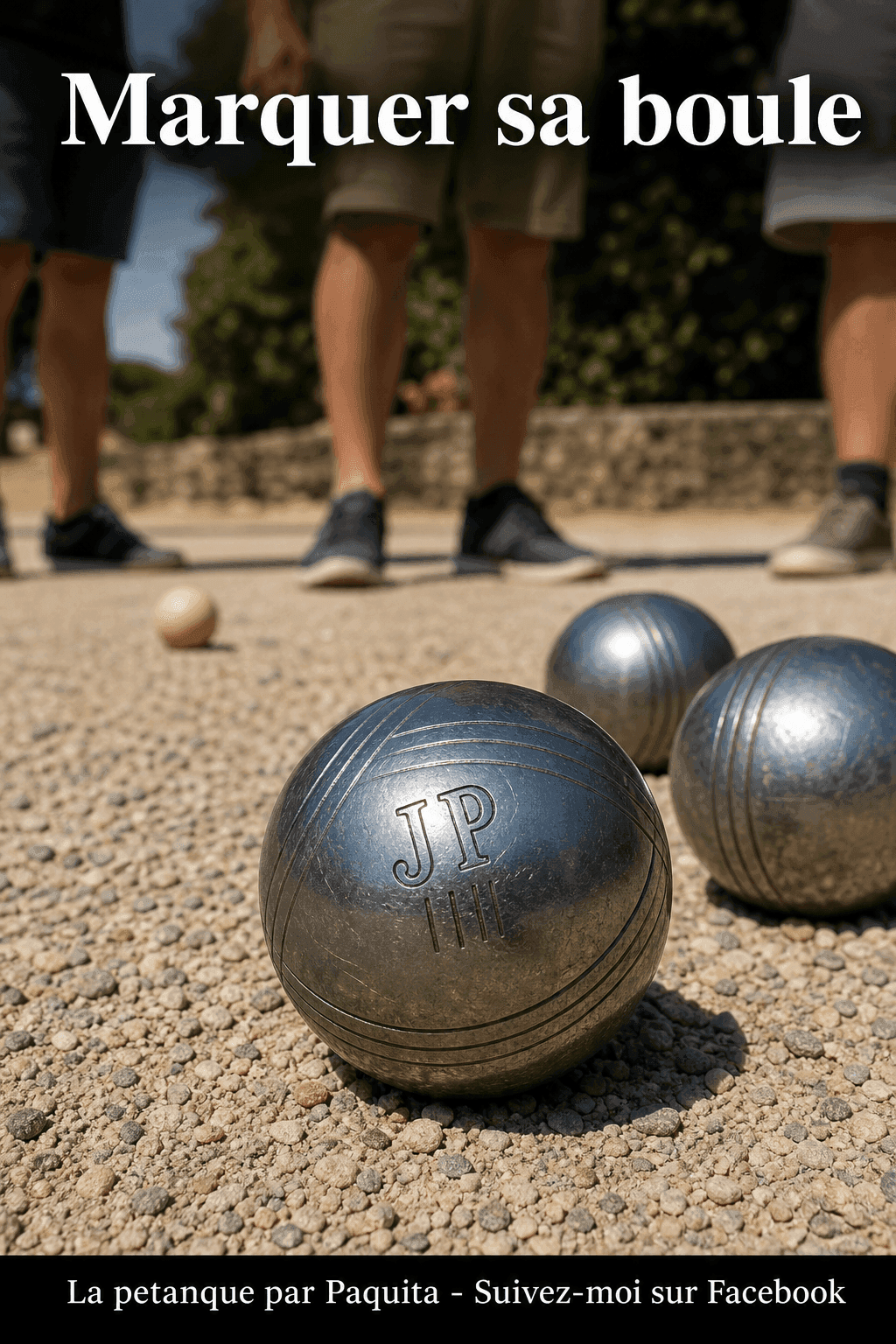
The marking is first used to identify a ball. Two sets can have the same appearance, the same diameter and similar grooves. Without a marker, confusion quickly becomes possible, especially when several balls are grouped around the goal. A clear brand avoids turning a simple check into an endless discussion.
It also serves to protect the position of a ball when play must be examined. Before a measurement, before an authorized withdrawal or during an accidental situation, the trace on the ground and the visual identification allow you to return to a consistent playing state. The rules seek one simple thing: that the game continues with as little arbitrariness as possible.
2.When should you score a boule during an end?
It is especially necessary to do it when the position becomes important: ball close to the goal, ball which interferes with a measurement, ball likely to be moved by a foot, another ball or a control gesture. Waiting for litigation to arrive is too late, because no one knows exactly what the initial position was anymore.
In practice, good players score before touching, before measuring and before calling for a decision. Marking is not theater: it must be discreet, legible and accepted by opponents.
To remember: a well-identified ball does not automatically prove right, but it makes the decision verifiable by the referee and acceptable to both teams.
3.How to score without provoking dispute?
The cleanest method is to announce what you are doing, then place a short, visible marker near the ball, without touching it. We don't scratch the surface in all directions and we don't create a brand that could change the situation. Sobriety is the best protection.
If the referee is called, we let the referee organize the check. A player who continues to manipulate the game during a dispute puts himself in difficulty.
4.Identify your game before the competition
Spot marking on the field does not replace the identification of one's own game. Engraved initials, known streaks, controlled weight and diameter: everyone must know how to recognize their boules without hesitation. This is even more true in competitions where several players use very similar models.
Before leaving, take thirty seconds to check that your three boules are indeed yours and that they remain consistent. This simple check avoids embarrassing situations when the game becomes tense.
Always keep the same routine: announce the ball in question, let the opponents watch, then mark or control only what is useful. Calmness is as important as precision.
5.Errors that turn a marking into a problem
Bad marking creates more conflict than it resolves. A trace that is too wide, a ball hit inadvertently or an announcement made afterwards can be enough to sow doubt. Good marking must always help the decision, never give the impression that a player is arranging the position.
This is why the best reflex remains collective: we announce, we let people see, then we act. When everyone has seen the same thing, the rest of the sequence becomes much smoother.
| Situation | Good reflex | Common mistake |
|---|---|---|
| Identified ball | Clear announcement | look for your streaks at the last moment |
| Delicate measurement | don't touch anything | pick up too quickly |
| Ball moved | spot before | put back to judge |
| Similar game | control the brands | mix up two nearby balls |
6.What does the referee do if the ball is contested?
The referee does not guess a missing position. It is based on what is visible, on the marks present, on consistent declarations and on the state of the game. The clearer the marking, the quicker the decision can be.
If nothing is verifiable, the decision may seem harsh to the team who feels wronged. This is precisely the goal of prevention: a good player reduces gray areas before they become disputes.
7.The simple routine to adopt at each competition
Before the game: recognize your play. During the match: do not touch anything without announcing. Before a measurement: mark if the position can become sensitive. After the decision: remove unnecessary marks to keep the terrain clear.
This routine does not slow down the game. It saves time, because it avoids long discussions. It also shows your opponents that you respect the game, which is very important in the atmosphere of a competition.
The Ultimate Guide to Pointing in Petanque
To better read the distances, trajectories and placements that create disputes, this guide helps to structure decision-making at the point.
Discover