Actualités · 11 April 2026
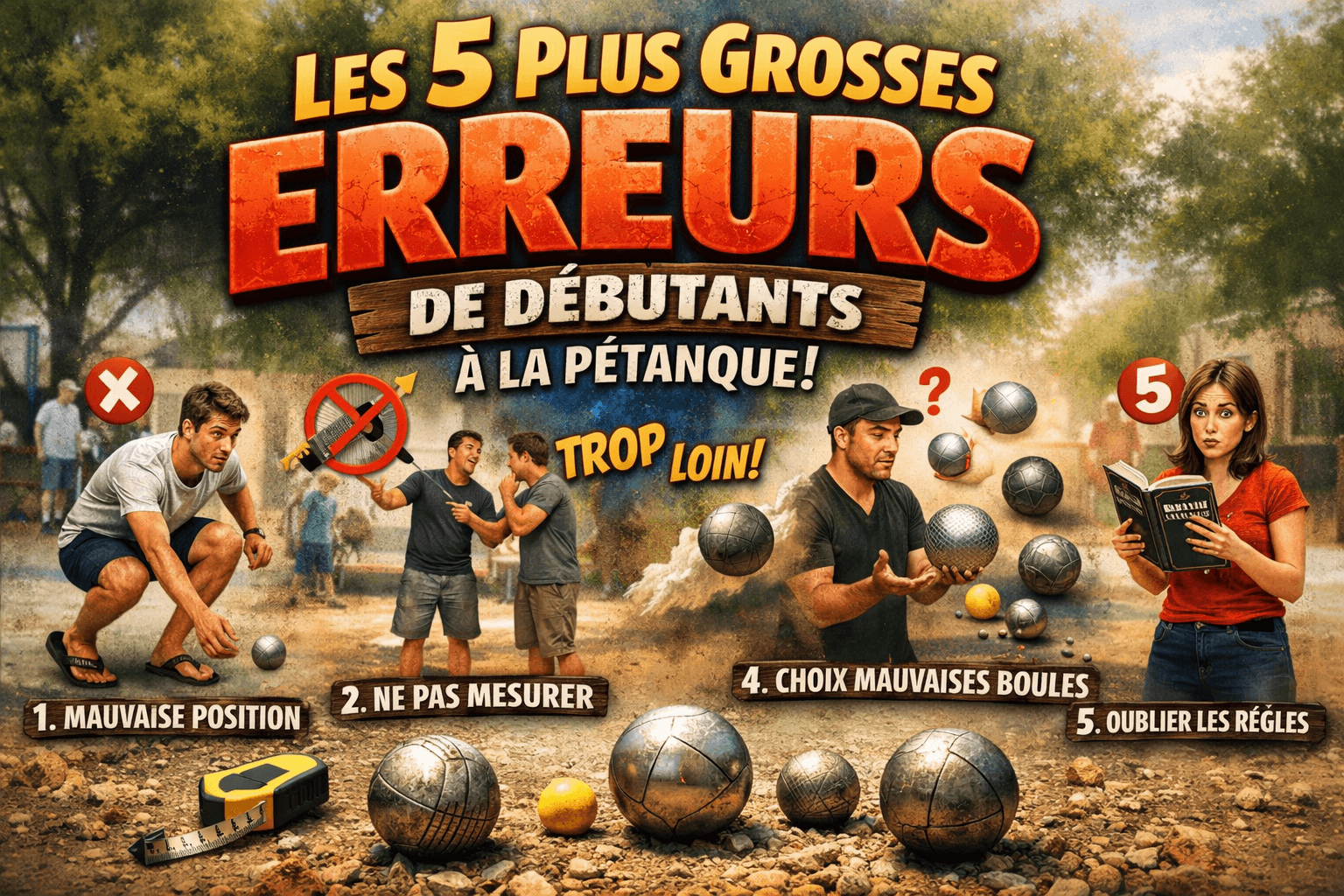
The 5 biggest beginner mistakes in pétanque (and how to avoid them)
There is good news and bad news. The bad: these 5 mistakes are so common that they define the “beginner” level in all clubs. The good thing: they can all be corrected quickly — as long as you identify them and work on them consciously. The problem is that most players don't know they're doing them. They think they are playing “normally”. They are progressing half as fast as they could. This article is the diagnosis that no oneMistake 1 — Playing with the wrong boules for too long
MISTAKE 01 The wrong boules for too long "I train with the garden boules, when I'm better I'll buy real ones." SEVERITY 9/10 🔴 TYPICAL SYMPTOMS- Unpredictable trajectories despite an identical motion from one throw to the next
- Inexplicable differences between two boules from the same box
- Boules that rust after a few weeks of normal storage
- Refusal by the referee at the first official competition
- Development of motion compensations to "correct" the equipment's defects
The beginner's logic seems unbeatable: "Might as well not invest if I don't know yet whether I'll get into it." The problem: non-approved leisure boules — supermarket, garden, toy — have inconsistent weights from one boule to another, approximate diameters and steel that doesn't last 6 months. The beginner learns to compensate for these inconsistencies with his motion. He develops bad habits to correct an equipment defect, not to improve his technique. When he finally switches to proper boules, he has to unlearn everything.
❌ WITH WRONG BOULES "I compensate for the fact that my n°2 boule is 18g lighter than the n°1 without knowing it. I develop an asymmetrical motion. I think I'm progressing. I'm regressing." ✓ WITH APPROVED BOULES "Each throw with the same motion gives the same result. I learn what works and what doesn't. The progress is real and measurable." ✓ THE CORRECTION Buy an approved FIPJP triplet from the start — a Geologic or MS Competition around €35–45 is largely enough to start seriously Choose the right weight: generally between 680 and 720g for most body types, to be tested by holding the boule in a full grip — it should hold without effort or tension Check that the 3 boules bear the same engraved weight — this is the first condition of a triplet usable in competition Never train with boules different from those used in competition — muscle memory calibrates to the exact weight ⏱️ TIME TO CORRECT Immediate — one purchase is enough. Adapting to the new weight takes 2 to 3 sessions.Mistake 2 — Watching the boule instead of the landing point
MISTAKE 02 Eyes in the wrong place "I aim at the jack — that's normal, isn't it?" SEVERITY 8.8/10 🔴 TYPICAL SYMPTOMS- Short or long points with no motion explanation — the motion "looks good" but the results are inconsistent
- Deviation at long distances while short distances are mastered
- Change of axis at the last moment — the boule "never goes where you aim"
- Eyes that "follow the boule" during the swing instead of staying fixed on the landing point
The natural reflex is to look at what you want to reach — the jack. But the boule doesn't land directly on the jack: it lands before short of it, at a landing point that the brain must calculate. If the eyes look at the jack, the brain guides the hand toward the jack — not toward the intermediate landing point. Result: the boule systematically overshoots, or the angle is wrong. In shooting, the same problem: aiming at the opposing boule often makes you miss because the eye doesn't fix on the right impact point.
❌ EYES ON THE JACK "I aim at the jack. My boule often goes past it, sometimes short. I don't understand — my motion is identical though." ✓ EYES ON THE LANDING POINT "I aim at a precise point on the ground, 50 cm before the jack. My eye no longer moves. My boule consistently arrives at the same spot. I control the distance." ✓ THE CORRECTION Before each throw, identify a precise landing point on the ground — not "near the jack" but an exact marker: a mark, a pebble, a different colour in the dirt Fix this point from the start of the pre-throw routine and don't take your eyes off this point until the end of the hand follow-through Concrete drill: place an object (bottle cap, coin) at the targeted landing point and aim at this object — not the jack. Gradually, you'll aim at the correct landing point naturally Never "follow the boule with your eyes" during flight — it's the motion that says the gaze leaves before the end of the release ⏱️ TIME TO CORRECT 1 to 2 weeks of conscious practice. The improvement is immediately visible on distance consistency. 🎙️ Paquita on the eyes "I've asked dozens of players: 'What do you look at when you point?' Near-unanimous answer: 'The jack.' And I then ask them: 'Does your boule land directly on the jack?' No, of course — it rolls up to it. So you're guiding your hand toward a target your boule isn't supposed to touch directly. It's not a motion error. It's a vision error. And it's the easiest one in the lot to correct." — PaquitaMistake 3 — Wanting to look good rather than being effective
MISTAKE 03 Aesthetics before efficiency "I want to shoot au fer because it's more impressive." SEVERITY 8/10 🔴 TYPICAL SYMPTOMS- Attempting the au fer shot systematically — even when shooting in front would have 3 times more chance of succeeding
- Choosing the "spectacular" shot rather than the "tactically correct" shot in the given situation
- Persisting with a difficult technique before having consolidated the basics
- Losing ends over inappropriate technical choices that the team doesn't challenge so as "not to offend"
The au fer shot is spectacular. The rétro is impressive. Long-range accuracy is socially valued on the boulodrome. The problem: a beginner who attempts the iron shot at 9 metres on sandy ground with a motion not yet ingrained loses his boule. A beginner who plays cleanly in front at 7 metres on hard ground scores. Pétanque is won in points, not in applause. The obsession with form at the expense of substance is probably the n°1 reason why beginners stagnate for years.
❌ AESTHETIC PRIORITY "I miss 7 iron shots out of 10 but the 3 that go in are magnificent. The opposing team is impressed. We lose the game." ✓ EFFICIENCY PRIORITY "I play cleanly in front 8 times out of 10 on decent ground. It's not spectacular. We win the game. I work on the iron shot in training." ✓ THE CORRECTION Define your dominant shot honestly: which one succeeds best in a real game situation (not in ideal training)? That's the shot you play in competition Work on difficult techniques (iron shot, rétro) exclusively in training until a sufficient success rate — minimum 60% in normal conditions — before introducing them in competition Learn to read the situation: ground, distance, score, remaining boules. The "good shot" is not the most beautiful — it's the one with the best risk/benefit ratio in the given situation Measure your success rate per technique over 3 training sessions — the figures are often a painful but liberating revelation ⏱️ TIME TO CORRECT It's a mentality mistake, not a technique one. Change is possible in 2–3 competitions once the decision is made.Mistake 4 — Playing a role you're not made for
MISTAKE 04 The wrong role in the team "I shoot because it's the most visible role. But I'm naturally a pointer." SEVERITY 7.5/10 🔴 TYPICAL SYMPTOMS- Recurring frustration in one's role — "I shoot but I never hit", "I point but it never goes in"
- The team systematically loses in situations that depend on your specific role
- Natural strengths are never used because the role doesn't require them
- Doubts about one's own ability to progress when the problem is just a wrong position
Shooter, middle, pointer — these roles are not interchangeable. They require different qualities and a different motion. The pointer needs distance precision and finesse. The shooter needs controlled power and angle reading. The middle needs both in smaller amounts. Many beginners choose their role by desire (shooting is more socially valued) or by default (the others have already chosen). Few are those who have chosen it by objective analysis of their strengths.
❌ WRONG ROLE CHOSEN "I've been shooting for 2 years. My success rate is 30%. I don't know why. One Sunday I point and I play my best game. I go back to shooting the following week." ✓ ROLE SUITED TO ONE'S STRENGTHS "I tested both. I measured. I'm a better pointer — more precision, less energy spent. I become the best pointer in my club in 6 months." ✓ THE CORRECTION Objectively test the two main roles over at least 5 games each — not in a single game but over a real testing period Measure: for the pointer, count the percentage of boules placed within a 30 cm radius of the jack. For the shooter, count the rate of boules hit. The figures don't lie Listen to your teammates — they often see from the outside what you don't feel from the inside. "You're a much better pointer than shooter" said with goodwill is worth months of trial and error Accept that the most useful role isn't necessarily the most glamorous — an exceptional pointer is as valuable as a formidable shooter ⏱️ TIME TO CORRECT 3 to 5 test games are enough to get a first reliable indication. Progress in the right role is often immediate and spectacular. 💡How to recognize your natural role quickly: if you are intrinsically patient and precision satisfies you more than power — you're probably a pointer. If you feel more satisfaction from destruction than from placement — shooter. If you're comfortable in both situations without excelling in either — middle. These natural tendencies reveal themselves by playing, not by theorizing.
Mistake 5 — Training without a method and hoping to progress
MISTAKE 05 Training without structure "I play 3 times a week. I should progress. But for 2 years, I've been at the same level." SEVERITY 9.5/10 🔴 TYPICAL SYMPTOMS- Playing a lot without ever working on a specific fault — you "play" but you don't train
- Unexplained progression plateau after a promising start
- No measurement of results — impossible to tell if you've improved over a given period
- Repeating the same mistakes without a conscious correction mechanism
- Changing technique after each miss without understanding why the shot missed
There is a fundamental difference between playing and and training. Playing consists of stringing together games hoping that repetitions will naturally do the work. Training consists of identifying a precise weakness, working on it with targeted drills, measuring progress and moving on to the next weakness. The vast majority of club players "play" — even when they think they're training. Repetition without correction intent produces no progress: it anchors faults as much as qualities.
❌ TRAINING WITHOUT METHOD "I throw 50 boules tonight. Some are good, others bad. I don't know why. I go home. Tomorrow the same." ✓ STRUCTURED TRAINING "Tonight I work only on the index finger release for the rétro. 30 throws. I note the result. I compare with last week. I know if I'm progressing." ✓ THE CORRECTION Identify a single priority weakness to work on per session — not five. Simultaneous correction of several faults is inefficient: the motor brain can only process one change at a time Measure before and after: count the success rate on the worked weakness before the session, work on it for 15–20 minutes, measure again. The progress — even minimal — is immediately visible and motivating Use targeted drills rather than free games: 15 minutes of structured drill is worth more than 2 hours of free play to anchor a specific technical correction Keep a session log — date, fault worked on, before/after score, observation. This log reveals progression patterns and resistances ⏱️ TIME TO CORRECT The method settles in 2–3 weeks. The effects on progress are visible in 1 month. Stagnation disappears in 2 months. 📊 The 15-minute structured rule15 minutes of structured training — with a precise goal, a before-and-after measurement, and an analysis of misses — are worth more than 2 hours of free games to progress technically. It's not an opinion: it's what motor memory science has been saying for decades. Progress comes from deliberate practice — not mechanical repetition. See our articles on pointing and shooting drills at home for concrete examples of structured sessions.
Summary — the 5 mistakes and their quick correction
| Error | Severity | Main cause | Key correction | Timeframe |
|---|---|---|---|---|
| 1 — Wrong boules | 9/10 | Short-term economy | Approved boule €35+ | Immediate |
| 2 — Eyes on the jack | 9 / 10 | Natural reflex | Aim at the landing point on the ground | 1–2 weeks |
| 3 — Aesthetics before efficiency | 8/10 | Ego / social validation | Play your dominant shot | Immediate decision |
| 4 — Wrong role | 7.5/10 | Non-objective choice | Test and measure both roles | 3–5 games |
| 5 — Training without method | 9.5/10 | Confusion between playing and training | Structured sessions with a goal | 1 month |
These 5 mistakes corrected, real progress begins. Paquita's book gives the complete method: 100 numbered drills, beginner → elite programmes, biomechanics and mental game. Everything you need to never stagnate again.
📦 Order on AmazonFAQ — Your frequent questions
Ces erreurs concernent-elles aussi des joueurs expérimentés ? + Absolutely. L'erreur 5 (entraînement sans méthode) touche des joueurs de 10, 15, 20 ans d'expérience qui jouent régulièrement mais ne progressent plus depuis des années. L'erreur 3 (esthétique avant efficacité) est souvent plus prononcée chez les joueurs confirmés que chez les vrais débutants — parce que l'ego est plus développé. L'erreur 4 (mauvais rôle) se maintient chez des joueurs de club qui n'ont jamais objectivement mesuré leur performance par rôle. Ces erreurs ne sont pas réservées aux débutants — elles définissent un état d'esprit, pas un niveau. Quelle est l'erreur la plus urgente à corriger en premier ? + Dans l'ordre logique : l'erreur 1 (boules) en premier car elle conditionne tout le reste — apprendre avec de mauvaises boules, c'est apprendre de mauvaises habitudes. Ensuite l'erreur 2 (regard) car elle affecte directement chaque lancer. Puis l'erreur 5 (méthode d'entraînement) car elle détermine la vitesse de correction des autres erreurs. Les erreurs 3 et 4 sont importantes mais moins urgentes — elles se corrigent naturellement quand les fondamentaux sont en place et que les mesures objectives montrent ce qui fonctionne vraiment. Comment mesurer objectivement ma progression pour savoir si je corrige vraiment ? + La méthode la plus simple : définissez un exercice précis (ex. : "boule posée dans un rayon de 30 cm du cochonnet à 7 mètres"), lancez 20 boules, comptez les réussites. Notez le score. Refaites l'exercice après 2 semaines de travail ciblé — le chiffre aura changé, ou pas. Si pas : la méthode de correction n'est pas la bonne, changez d'approche. Si oui : continuez. Cette mesure binaire simple vaut mieux que tout ressenti subjectif. Pour le tir : taux de touches sur 20 tirs à distance fixe. Les chiffres ne mentent pas. Est-ce qu'un bon équipier peut m'aider à identifier mes erreurs ? + Oui — et c'est souvent le moyen le plus rapide. Un équipier bienveillant et attentif voit des choses que vous ne ressentez pas (la position des yeux, l'axe du pendule, la crispation de la main). Demandez-lui d'observer un seul aspect à la fois — pas "qu'est-ce qui ne va pas globalement" mais "est-ce que mes yeux bougent pendant l'élan ?" ou "est-ce que je semble crispé au lâcher ?". La question ciblée donne une observation utile ; la question ouverte donne souvent un retour vague. La vidéo est encore plus efficace — filmez-vous de côté sur 10 lancers et regardez. Vous verrez probablement vos erreurs vous-même. 📎 Related articles Equipment How to choose your pétanque boules — 2026 guide Equipment Stainless steel vs carbon — what impact on your game? Rules Complete FFPJP rulebook 2026 Video Why changing bowls does not change your level Equipment Top 3 best shooter boules 2026 Tools Free PetanqueLand tools© Pétanque by Paquita — petanqueland.fr · 📖 Paquita's book on Amazon