Actualités · 6 April 2026
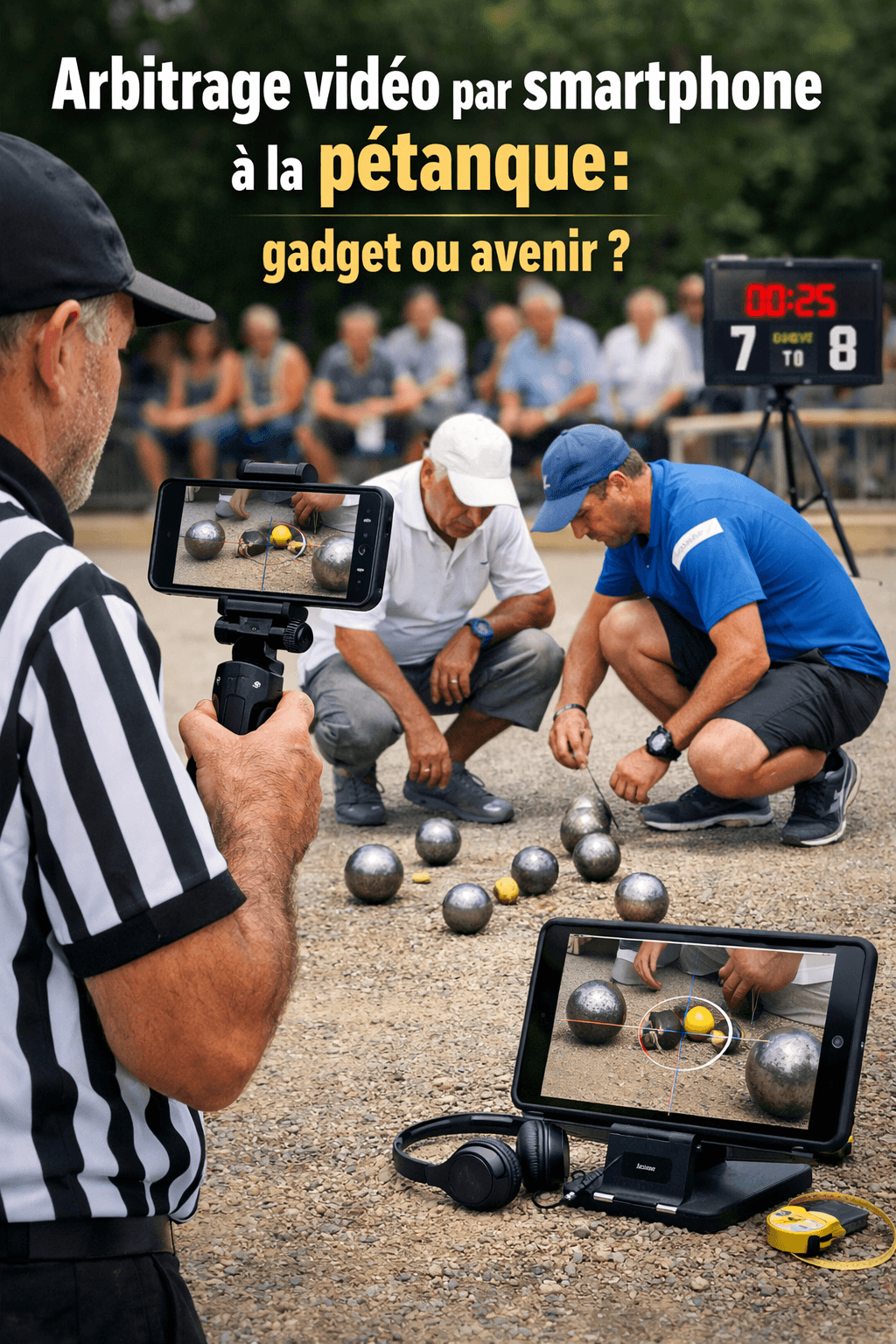
Video officiating on a smartphone in pétanque: Gadget or the future?
The scene is familiar to every player: two balls 2 millimeters apart, no one wants to give in, the tape measure gives a measurement that satisfies no one, and the referee is at the other end of the bowling alley on another dispute. “Wait, I’m filming.” For several years, the smartphone has been installed in this void — first unofficially, then with real thought surrounding its framework. In some championships, the video is already there. In the clubs, it is debated. Paquita dismantlesThe concrete problem — why tech is moving onto the terrain
Before debating the solution, let's face the problem. Pétanque regularly produces refereeing situations where the margin of human error is greater than the actual gap between two boules. And that generates conflicts.
📍 Typical dispute scene — tight finish to an end Team A"My boule is closer, look — it's clearly in front." Team B"Nonsense, it's mine. What does the tape say?" Team A"The tape says 12.3 cm for both. That's a useless measurement." Team B"Wait, I filmed it with my phone from the side." Umpire (arriving 3 minutes later)"I wasn't here, I can't rule on something I didn't see." → Result: disagreement, game slowed down, atmosphere soured. And nobody really knows who was right.This scenario is repeated hundreds of times a week in clubs and competitions across France. The manual tape measure, pétanque's standard tool for decades, reaches its physical limits as soon as the gap between two boules is less than 3 millimeters — because of the tape's deformation, the reading angle, and the operator's subjectivity. Video and laser measurement exist precisely to fill this gap.
🎙️ Paquita on the root of the problem "The problem isn't the technology. The problem has existed as long as pétanque has existed: two boules too close together, an imprecise measurement, and two teams that don't trust each other. Video and the laser don't create this problem — they offer an answer. The real question is whether we want an objective answer or whether we prefer conflicts to be settled the old-fashioned way, by the force of character of the most heavily built captain. Some still prefer that method. It's a societal choice." — PaquitaThe tools available today
An inventory of what actually exists, with what it costs and what it really brings on the terrain.
📱 Standard smartphone video Filming the end from the side with any recent smartphone. 4K resolution allows sufficient digital zoom for disputes with a 5–10 mm gap. 120–240 fps slow motion helps for impacts and boule movements. ✓ Available — €0 🔴 Laser rangefinder Small devices measuring distance with ±1 mm precision. Available from €25–40. Some clubs have already equipped their umpires with them. Definitively resolves distance disputes between boules and the jack. ✓ Available — €25–100 🤖 AI refereeing apps Mobile apps that analyze a photo taken from above and automatically calculate which boule is closest. Precision depends on the shooting angle and lighting. A few apps in development in 2025-2026. ⚠ In development 🎥 Fixed terrain cameras Permanent installation of overhead cameras above the terrains. Already present in some professional championships. Significant installation cost. Provides a permanent overhead view usable for refereeing. ⚠ Pro championships only 👁️ Remote video refereeing (pétanque VAR) Real-time video transmission to a central umpire who reviews and rules from a room. Tested in a few international competitions. Average decision delay: 90 seconds. ✗ Experimental only 📐 Photogrammetric measurement 3D reconstruction of the boules' position from several photos. Millimetric precision. Used in a few world championships. Requires dedicated software and a trained operator. Unsuitable for club play. ✗ Elite competition onlyArguments for and against — the full debate
✓ ARGUMENTS FOR 🎯Objective precision: a laser measurement or 4K video isn't wrong by 2 mm. It settles things where the tape measure and the human eye regularly fail. ☮️Fewer conflicts: an objective truth isn't arguable. Video cuts disputes short and preserves the mood of games — especially in competitions. ⚖️Competitive fairness: in a competition with stakes, a wrong refereeing decision can change the outcome of a match. Technology protects sporting fairness. 💰Affordable cost: a precise laser rangefinder costs less than an entry-level triplet of boules. It's not luxury equipment reserved for the big federations. 📱Already there de facto: players already film disputes with their phones. Might as well regulate a practice that exists rather than ignore it. 🌍International credibility: competitions that want to exist at the highest level need modern refereeing standards to be taken seriously. ✗ ARGUMENTS AGAINST ⏱️Slowing down the game: each video referral adds 2 to 5 minutes to an end. In a competition with 20 simultaneous games, it creates refereeing bottlenecks and endless games. 🧓Generational divide: a significant share of players — often the most experienced — are resistant to technology or uncomfortable with it. Imposing it with no transition creates tension. 🎭Soul of the game: pétanque has a human and friendly dimension that's part of its identity. Turning every dispute into a tech procedure dehumanizes a sport that lives by its boulodrome culture. 📹Shooting angle: a video filmed from a bad angle can mislead more than it clarifies. A poorly framed video proof is worse than no proof at all. 🚫Potential abuse: if video becomes a systematic recourse, every team will film every end to contest it. Pétanque becomes procedural and games become unmanageable. 🏅Unsuited to amateur play: the constraints of professional championships don't apply to a village competition. Importing a professional setup into an amateur context is often unsuitable.In which cases it really changes something
✅ Regional or national championship final — FOR Here, the precision of refereeing has a direct impact on the official sporting result. Video and the laser are not only suitable but necessary. An erroneous refereeing decision in a national final is unacceptable with the tools available today. The delays are acceptable because few games are played simultaneously. → Technology fully justified and necessary ✅ Laser rangefinder as competition umpire equipment Replacing the tape measure with a laser rangefinder in the umpire's kit is a logical, inexpensive evolution with no impact on the pace of play. It's faster than a tape measure, more precise, and changes nothing about the philosophy of the game. It's probably the first evolution to roll out widely. → Immediate adoption recommended — no downside ⚠️ Club competition with 20 simultaneous games — NUANCED On-demand video is viable if it is regulated — a maximum of one request per team per game, with an umpire reviewing quickly on the spot. Without regulation, it creates queues and cascading disputes. The rule must be clear before the competition begins. → Viable if protocol defined in advance ⛔ Friendly neighborhood game between friends — AGAINST Pulling out your phone to referee a friendly game between friends changes the atmosphere of the game. Leisure pétanque doesn't need millimetric precision — it needs good humor and conviviality. The truth of a friendly game is settled by feel, common sense and the drink that follows. → Counter-productive for leisure play 📹 Checking the validity of a throw or a boule being moved Video is particularly useful for checking whether a boule moved before being played, whether a foot lifted in the circle, or whether sweeping took place. These infractions often go unnoticed to the naked eye and video replay can definitively settle situations that create strong tensions. → Relevant and hard-to-dispute useWhat other sports have learned from video
Pétanque isn't the first to take this step — or to hesitate to take it. Other sports' experiences are instructive.
| Sport | Technology adopted | Result | Lesson for pétanque |
|---|---|---|---|
| Football | VAR since 2018 | Mixed | Video slows down celebrations and generates controversies over definitions. The imprecision of the rule doesn't disappear with tech. |
| Tennis | Hawk-Eye since 2006 | Success | Fast decision (5 sec), limited to disputed cases, accepted by players. A model to follow for targeted use. |
| Cricket | DRS (Decision Review System) | Success | Each team has a limited number of reviews — it prevents abuse and maintains the pace. |
| Rugby | TMO (try video) | Success | Used only for disputed tries, not for every tackle. Delimiting the scope is key. |
| Boules lyonnaises | Laser rangefinder | Adopted | The sister discipline adopted the laser without major controversy. A direct model for pétanque. |
| Curling | Electronic measurement | Success | Electronic measurement replaced the manual compass. Nobody misses the compass. |
Hawk-Eye in tennis is often cited as the best example of successful video integration. Why does it work? Because its scope is precise and limited (is the ball in or out?), the decision is fast (5 seconds), the review is limited in number (3 per set), and players have culturally accepted it before being forced to. Pétanque would do well to draw inspiration from this model rather than from football's VAR — which has become as much a problem as a solution.
What the FFPJP says (and doesn't say)
📋 STATE OF THE RULES IN 2026 The current FIPJP and FFPJP rulebook contains no specific provision on the use of the smartphone or video in refereeing. This regulatory silence creates a vacuum that competition organisers and umpires address in different ways: some accept video as a decision-making aid, while others reject it on the grounds that "the umpire's decision is final". The specific regulations for some championships have begun to explicitly state the conditions for using electronic measuring tools—but this is not yet widespread.The The FFPJP has set up working groups to explore modernising umpiring tools. Laser rangefinders are viewed favourably in several working papers. Their official inclusion in the rules is likely in the medium term. The question of mobile video remains more controversial. ⚠ The regulatory vacuum causes real problems
The lack of a clear rule on video and laser use in official competitions leads to absurd situations: an umpire refusing to watch perfectly clear footage, or a team disputing a decision by producing a recording that no one is officially allowed to consider. Precise rules—even restrictive ones—are preferable to this vacuum. The umpire needs to know what they may and may not use.
Views from the field — umpires, players, clubs
🦺 REGIONAL FFPJP UMPIRE In favour—with safeguards"The laser, yes, without hesitation. It puts an end to arguments over close measurements. Video too, yes, but with a clear protocol and a maximum time limit. Without rules, I'm the one left to manage the chaos."
👴 PLAYER WITH 30 YEARS' EXPERIENCE Against—with reservations"We played for 30 years without it and disputes still got settled. The problem today is that we no longer trust one another. A phone doesn't solve the underlying problem—mistrust between players."
🏅 COMPETITIVE NATIONAL-LEVEL PLAYER Fully in favour"At the French Championships, I've seen wrong decisions cost teams matches. A one-centimetre error can mean elimination. At this level, accuracy is not optional."
🏠 LOCAL CLUB PRESIDENT Mixed view"I've equipped my umpires with laser rangefinders—zero problems. I allow video for finals, but not during the group stage. That's the compromise that works for us."
👩 RECREATIONAL CLUB PLAYER Against—for casual play"I play for fun. If people start pulling out their phones for every end, I'm leaving. For me, enjoying each other's company is the only rule that matters."
👨💻 PÉTANQUE APP DEVELOPER In favour—the future"In five years, accurate, standardised apps will be available. The question will no longer be whether we use them, but how. The federation would do well to take charge of the issue now."
Paquita's verdict
🎯 Neither a gimmick nor a revolution—a tool to use judiciously Technology in pétanque umpiring is neither a threat to the soul of the sport nor the solution to all its problems. It is a tool whose relevance depends entirely on the context.The laser rangefinder should already be in every official competition umpire's kit—it is fast, accurate, inexpensive and changes nothing about the philosophy of the game. It is the simplest and most effective improvement available today.
The smartphone video is legitimate in serious competition when governed by a clear protocol—a limited number of reviews, a maximum time limit, and the umpire having final authority over the interpretation. It has no place in a friendly game.
What is certain is this: the current regulatory vacuum is the real problem. Not the technology. A clear rule—even a restrictive one—is infinitely better than the current free-for-all, where each umpire decides alone what they will or will not accept. 📖 PAQUITA'S BOOK Method—not technology
Laser or no laser, the fundamentals of the game do not change. Paquita's book covers technique, the mental game and tactics through 100 numbered exercises. Because good technique is beyond dispute.
📦 Order on AmazonFAQ — Your frequent questions
Can I film a contentious match with my phone in an official competition? + The current FFPJP regulations do not explicitly prohibit it, but neither do they allow it as an official arbitration tool. In practice, you can film for your own use — but the arbitrator is not required to take your video into account when making his decision. Some referees accept it as a visual aid, others refuse. The only way to have a certain answer is to check the specific rules of the competition or ask the head referee before the first game. The situation should become clearer soon with the regulatory modernization work underway at the FFPJP. Is a laser rangefinder allowed to measure instead of the tape measure? + The regulation speaks of "measuring instrument" without specifying the type. The laser rangefinder can therefore be interpreted as a legitimate measuring tool — and many referees already use it. However, in the event of a formal dispute during an official competition, the decision rests with the referee and the organizer. To avoid any ambiguity, it is best to check the specific rules of the competition or to speak to the chief referee. In fact, the laser is rarely contested because its measurements are more precise and less questionable than the tape measure. Will the FFPJP integrate video into its regulations? + The FFPJP has active working groups on the modernization of arbitration. The laser rangefinder appears to be the first development to come — discussions are underway to officially integrate it as an approved refereeing tool. Mobile video is a more complex subject, with divergent positions within the federation. A supervised experiment in certain championships seems the most likely step before possible formalization. See our article on laser measurement and video refereeing in clubs for the latest information. Isn't technology likely to kill the spirit of pétanque? + This is the legitimate fear that comes up most often in clubs. It deserves to be taken seriously. Pétanque has a culture of bowling, conviviality and human refereeing which is part of its identity. But two things must be distinguished: the tool and the context in which it is used. A laser rangefinder used discreetly by a referee does not kill the spirit of the game any more than a measuring tape. A systematic video released each time leads to a friendly game between friends - yes, that's a problem. The tool has no soul; it is the use we make of it that defines whether we preserve or destroy the spirit of sport. Which clubs have already adopted laser or video? How is it going? + Several clubs in the South of France and the Paris region have equipped their referees with laser rangefinders for 2–3 years. The feedback is mostly positive: fewer disputes over close measurements, quicker decisions, more calm referees. Video is adopted more timidly — some clubs only allow it in the final of annual competitions. No club has generalized it to all games without rhythm problems appearing. The rule that seems to work everywhere: laser yes systematically, video only on request and only for critical leads with a maximum deadline imposed. 📎 Related articles Refereeing Laser measurement and video refereeing in your clubs Rules Complete FFPJP rulebook 2026 Regulations 2026 Regulations — what is really changing Refereeing Pétanque officials — roles and responsibilities Video Umpiring videos — game situations with commentary Tools Free PetanqueLand tools© Pétanque by Paquita — petanqueland.fr · 📖 Paquita's book on Amazon