Actualités · 7 April 2026
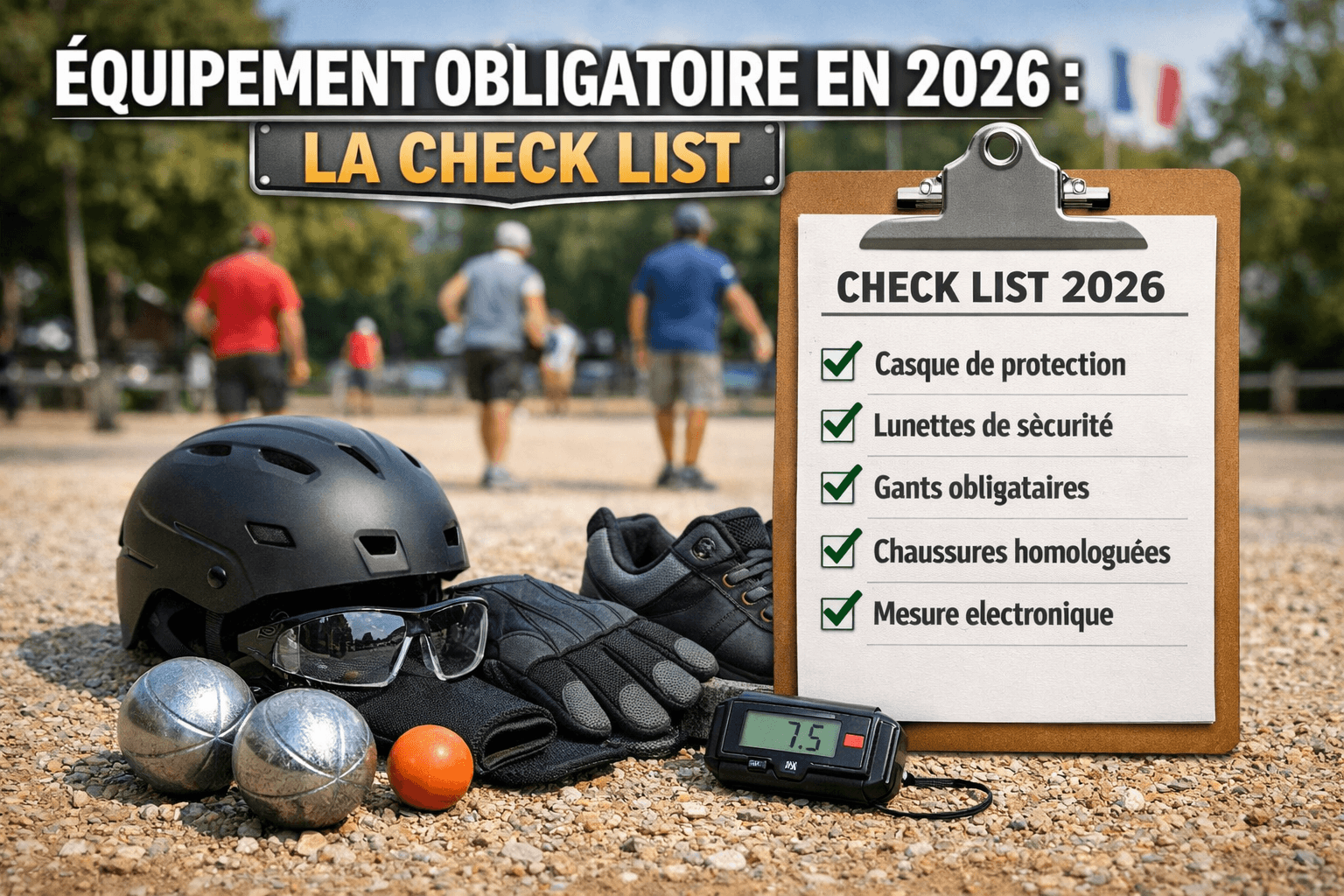
Mandatory equipment in 2026: the checklist
You arrive at the competition. The referee controls the balls. He checks the outfit. He asks for the license. And there — missing a detail. Result: forfeit on the first part, or worse, exclusion during the competition. It happens. Often for stupid oversights, resolved in two minutes if we had checked the day before. This checklist is here so you never have that conversation with a referee. 7 mandatory points checked by the referee before the first shot 3 new features coming into force or reinforcedThe mandatory check-list — what the referee checks
These items can be checked at any time during an FFPJP-approved tournament. The referee is sovereign in their checks.
✅ MANDATORY — Before the first game 7 points ✓ Valid FFPJP licence Licence valid for the current sporting season. Digital format accepted since 2024 — QR code on smartphone valid. Check the year of validity before you leave. See: Dematerialised FFPJP licence Unchanged ✓ FIPJP-approved boules — complete triplette Each boule must bear the FIPJP approval number engraved on it, with the weight and manufacturer. 3 boules mandatorily identical in weight for a single player in a triplette. No replacement boule during a game without the referee's agreement. Unchanged ✓ Compliant sports kit Strengthened 2026 new feature: sports kit mandatory in all FFPJP-approved tournaments. Jeans, swim shorts, beach dresses and flip-flops are formally prohibited. See the dedicated section below. See: Prohibition of jeans in 2026 New 2026 ✓ Rigid throwing circle (35 to 50 cm in diameter) Rigid circle mandatory since 2025-2026 in approved tournaments. Free material (plastic, rubber, metal). Internal diameter: 35 to 50 cm. A circle traced with the foot in the dirt or a simple line are no longer accepted in official tournaments. See: Rigid circle mandatory 2026 New 2026 ✓ Approved jack (30 to 35 mm) The jack must measure between 30 and 35 mm in diameter. In practice, jacks sold in specialist shops are almost always within these standards. Cork stoppers, marbles or repurposed objects are prohibited. The team that throws the jack is responsible for its compliance. Unchanged ✓ Tape measure or measuring instrument At least one measuring instrument per team is required in official tournaments — either a classic tape measure or a laser rangefinder. The laser rangefinder is now accepted as an official measuring instrument in most tournaments. A single unit is enough for a triplette. Laser recommended ✓ Closed shoes — feet covered Feet must be wearing closed shoes. Flip-flops, open sandals and backless shoes are prohibited in official tournaments — for safety reasons (boule impact) and dress-code rules. A low sports shoe is sufficient. UnchangedBoules: the exact 2026 standards
Boule checks are the most frequent inspection point and the one that generates the most exclusions. Here are the exact standards applicable in 2026.
⚙️ FIPJP STANDARDS — PÉTANQUE BOULE 2026 Minimum weight 650g Below = boule refused immediately Maximum weight 800g Above = boule refused immediately Minimum diameter 70.5mm Measured across several axes Maximum diameter 80mm Sphericity tolerance controlled Mandatory marking FIPJP no. + weight + manufacturer engraved on the boule Surface Smooth No cavity or artificial roughness altering the behaviour 🔍 How to check your boules before the tournamentLook for the FIPJP approval number engraved on each boule (not printed, not glued — engraved). If you can't find a legible number, your boules are not approved. Also check that the engraved weight matches your scale — over the years, some boules wear slightly. Finally, the three boules of a triplette must all bear the same engraved weight to be played together. See our full article: How to check the approval of your boules
⚠ Modified boules — immediate sanctionAny boule whose surface has been intentionally modified after manufacture (added grooves, filling, altered bore) is considered non-compliant and results in the player's immediate exclusion from the tournament. No prior warning — the sanction is direct and with no appeal possible at the time.
Clothing: allowed vs prohibited in 2026
Sports kit has been mandatory in all FFPJP-approved tournaments since 2026. The rule was strengthened this season with reduced tolerance from referees on borderline cases.
✓ ALLOWED ✓ Tracksuit, sports tracksuit ✓ Sports shorts (football, running type) ✓ T-shirt, polo, sports jersey ✓ Sports jacket, windbreaker, sports raincoat ✓ Closed sports shoes ✓ Cap, bucket hat, beanie (no straw hat) ✓ Sports leggings, cropped sports trousers ✓ Club-coloured kit allowed ✗ PROHIBITED ✗ Jeans (whatever the cut) ✗ Swim shorts, beach shorts ✗ Dress, skirt (non-sport) ✗ Dress shirt, formal shirt ✗ Flip-flops, open sandals ✗ Bare feet ✗ Straw hat, formal hat ✗ Non-sport kit in general 👕In the event of non-compliant kit, the referee must give the player time to change before sanctioning — provided a replacement kit is available in the bag or the vehicle. If the player cannot comply within the allotted time, the game may be declared a forfeit. Tip: always keep a tracksuit in the car. See: full article on the mandatory sports kit 2026
The throwing circle — rigid mandatory in 2026
⭕ RIGID CIRCLE — EXACT STANDARDS New 2026 ✓ Internal diameter: 35 to 50 cm The FIPJP standard allows a diameter between 35 and 50 cm internal diameter. 50 cm circles (the common diameter of circles sold in shops) are within the standard. A circle that is too large or too small may be refused by the referee. Rigid mandatory ✓ Rigid material — plastic, rubber or metal The circle must be physically rigid — not a traced circle, not tape on the ground, not a drawing in the dirt. Flexible plastic circles from shops are accepted provided they hold their shape during the throw. A circle that flattens under the foot must be replaced. Unchanged ✓ Circle placed on the ground — not fixed The circle cannot be fixed or nailed to the ground. It must be placed freely. However, nothing forbids stabilising it slightly if the terrain is on a slope. A minimum of one circle per team — in practice, each player is best off having their own to play simultaneously. Unchanged 🎙️ Paquita on the rigid circle "A rigid circle is 3 € in any sports shop. Since it became mandatory, I've seen players get excluded from an end for tracing a circle in the dirt 'as usual'. Habit is no use against a referee who applies the rules. The rigid circle in the bag — like the boules and the tape measure. It's a box to tick, not a debate." — PaquitaThe recommended check-list — what makes the difference
💡 RECOMMENDED — Not mandatory, but strongly advised 9 points ★ Laser rangefinder Advantageously replaces the tape measure. Accuracy ±1mm, measurement in 1 second, removes measuring disputes. Cost: 25–60 €. The most profitable investment in your tournament bag. Many clubs already equip their referees with them. Recommended ★ Spare boules in the bag A lost, damaged or referee-removed boule may require replacement during a tournament. Having an approved boule of the same weight in the bag avoids a forfeit. The replacement must be validated by the referee. Precaution ★ Cloth and boule maintenance oil A clean cloth to dry the boules between games and a light oil for maintenance. Wet or dirty boules can slightly alter the grip. It's not mandatory but players who use it keep their equipment in better condition over time. Maintenance ★ Spare kit (tracksuit in the car) If the referee flags non-compliant kit, you need to be able to change quickly to avoid a forfeit. A sports tracksuit in the bag or car solves the problem in 5 minutes. See the clothing section above. Caution ★ Boule storage bag Boules carried loose in a sports bag risk knocking against each other and getting damaged. A specific bag with compartments protects the boules and identifies you as a seriously equipped player. No regulatory obligation, but a plus for the equipment's lifespan. Maintenance ★ Distinctive markings on the boules (grooves, dotted lines) In tournaments with several teams from the same club, identical boules can get mixed up. A distinctive marking (custom grooves, indelible marker on the number) helps quickly identify your boules and avoids confusion during an end. Practical ★ Spare jacks (x3 minimum) A jack can be lost, broken or swallowed up in the vegetation. Having 3 approved jacks on you guarantees the continuity of play without delay. The lost jack must be replaced at the same distance according to the rules. Practical ★ Sun protection and hydration A 12-hour tournament in summer without sun protection or water is a recipe for heatstroke. It's not a pétanque rule — it's common sense. See our article: Surviving a 12-hour tournament in 35°C heat. Health ★ Printed FFPJP rules or app In the event of a dispute over a rule of play, having the rules available — on smartphone or printed — allows a quick decision. The referee is sovereign but may refer to the text in an exceptional situation. Useful especially for rare situations. ReferenceWhat is formally prohibited
⛔ PROHIBITED — Risk of immediate sanction 6 points ✗ Non-approved or modified boules Supermarket boules, boules without a FIPJP number, boules whose surface has been modified after manufacture (carved grooves, filling). Sanction: immediate exclusion from the tournament. See our article: Checking the approval of your boules Exclusion ✗ Playing without having your feet in the circle At the moment of the throw, both feet must remain in the circle, in contact with the ground, until the thrown boule touches the ground. A foot that overhangs or lifts before the boule lands is a fault. In official tournaments, it's a yellow card on the first offence. Yellow card ✗ Sweeping the terrain before throwing Sweeping, blowing, moving stones or obstacles in the playing area before throwing has been an infringement since 2025-2026. Yellow card for the offending player. In the event of a repeat offence, red card and exclusion from the end. See: Sweeping rules 2026 Yellow card ✗ Hiding or masking the jack Putting your hand, foot, or any object in front of the jack to mask it from the opponent is formally prohibited. The jack must be visible to all players at all times during the end. Yellow card ✗ Disrespectful language or unsporting behaviour Insults, provocations, intimidating behaviour towards opponents, referees or spectators are sanctioned directly according to severity. The 2026 rules provide for strengthened sanctions for unsporting behaviour after several incidents reported in tournaments. Yellow/red card ✗ Playing with another player's boules without authorisation Each player must play with their own assigned triplette. Playing with a teammate's boules without the referee having validated a swap (in the event of a lost or defective boule) constitutes an irregularity. The end may be invalidated. End cancelledSpecifics by player category
🌱 Minimes (under 12 years old)Lightened boules allowed from 600g minimum. Adapted diameter possible depending on the category. Sports kit identical to adults. Rigid circle mandatory as for everyone.
🎒 Cadets / Juniors (12–18 years old)Standard boules from 650g. Same rules as adults for equipment. The FFPJP youth licence is mandatory — distinct from the adult licence.
👩 WomenNo exemption on equipment compared to the general rules. Same FIPJP approval, same weight and diameter standard. Women's sports kit (leggings, tracksuit, sports polo) is fully compliant.
🧓 Veterans (60+)Same general rules. No specific exemption on equipment. Lighter boules (within the 650–800g range) may be chosen for comfort — this is within the rules.
♿ Disability sportSpecific adaptations exist for FFPH disability sport competitions. The circle may be replaced by a seat or an adapted position validated by the referee. Enquire with the disability pétanque federation.
🌍 International competitionsFIPJP rules apply strictly. No national exemption is accepted. Boule checks are systematic before major competitions. International approval required.
Sanctions — what awaits you if you're not in order
WARNING First offence regarding kit or circle A verbal warning is given by the referee. The player has a time limit (usually 15 minutes) to comply — change, bring a rigid circle. If compliance is restored within the time limit, no further sanction is applied. YELLOW CARD Playing fault (foot outside circle, sweeping, masking jack) Yellow card for the offending player. The boule played in infringement may be cancelled and put back into play by the referee. In the event of two yellow cards in the same game, the player receives a red card. RED CARD Repeat offence or serious unsporting behaviour Exclusion from the current end. The team continues the game short-handed for that end. In the event of very serious behaviour (serious verbal violence, assault), the referee may pronounce exclusion from the tournament. FORFEIT / EXCLUSION Non-approved boules or a non-corrected non-compliance The game is declared a forfeit (0-13) for the offending team. In the event of modified boules or established fraud, exclusion from all tournaments for the season may be pronounced by the league's disciplinary commission. 📖 PAQUITA'S BOOK The method to equip yourself well AND play wellCompliant equipment is the foundation — but it's your game that makes the difference. Paquita's book covers the complete biomechanics, the 100 exercises and the mental management to become a formidable shooter.
📦 Order on AmazonFAQ — Your frequent questions
Are the balls purchased from Decathlon approved? + Decathlon sells both FIPJP approved balls (Geologic Competition range) and non-approved leisure balls (Initiation or Beach range). The distinction is simple: check if the box says “FIPJP approved” and if each ball has an engraved approval number. Without these two elements, boules are recreational and will be refused in official competitions. To find out more: article on checking the approval. My circle is made of soft plastic — is it accepted? + A soft plastic circle is acceptable provided that it maintains its circular shape when placed on the ground and a player stands in it. If the circle flattens or distorts underfoot to the point that it is no longer circular, it may be disallowed by the referee. Rigid plastic or thick rubber hoops sold in specialty sports stores are generally okay. When in doubt, invest in a quality hard circle — they cost between $3 and $15 and last for several seasons. Is the digital license on smartphones really accepted? + Yes, since the generalization of the FFPJP dematerialized license, the QR code displayed on your smartphone is accepted as proof of a valid license. Make sure your phone is charged and you have access to the app or your license email. In the rare cases where an arbitrator requires the paper version, it is an outdated but legally questionable practice — dematerialization has been officially adopted by the FFPJP. See: article on the digital FFPJP licence. Can we play with shooting balls for pointing or vice versa? + Yes, totally. The regulations do not distinguish between “shooter balls” and “pointer balls” — these designations are commercial, not regulatory. What matters is that the balls are FIPJP approved and within the weight and diameter standards. A pointer can easily play with hard balls with deep grooves typical of shooters, and vice versa. The choice of hardness, ribbing and weight within the legal range is entirely up to the player. What should I do if I discover that my boules are no longer up to standard during a competition? + If the referee notices a non-compliance during the competition (ball slightly below weight after wear, illegible marking), the procedure depends on the seriousness. A slightly worn ball but within tolerances can continue to be played. If non-compliance is proven, you can replace it with an approved reserve ball - that's why it is advisable to have one in your bag. If you don't have one, the game continues with two balls for your team. In serious cases of intentional modification, exclusion is immediate. If in doubt, tell the referee yourself before he finds out — it always works in your favor. 📎 Related articles Equipment How to check the FFPJP approval of your boules 2026 Rules The mandatory rigid circle — everything you need to know 2026 Rules Prohibition of jeans — mandatory sports kit 2026 2026 Rules Sweeping and cards — the new 2026 rules Equipment Choosing your pétanque boules — 2026 guide Rules Complete FFPJP rulebook 2026© Pétanque by Paquita — petanqueland.fr ·
📖 Paquita's book on Amazon
Check-list based on the FIPJP and FFPJP rules in force for the 2026 season. Some points may vary depending on the specific rules of the tournaments — always check the organiser's rules.