Règlement FFPJP · 1 August 2026
Tenue en concours : chaussures, couvre-chef et météo
Chaussures, casquette, bonnet, pluie ou chaleur : les repères utiles pour une tenue de concours sûre, cohérente et sans litige.Rain, heat, cold, cap or shoes: the authorized outfit must remain sporty, safe and compatible with the event. The objective of this article is simple: to separate the applicable rule, the tolerance of the field and the bad habits which create unnecessary arguments.
1.The weather does not cancel out the sporting environment
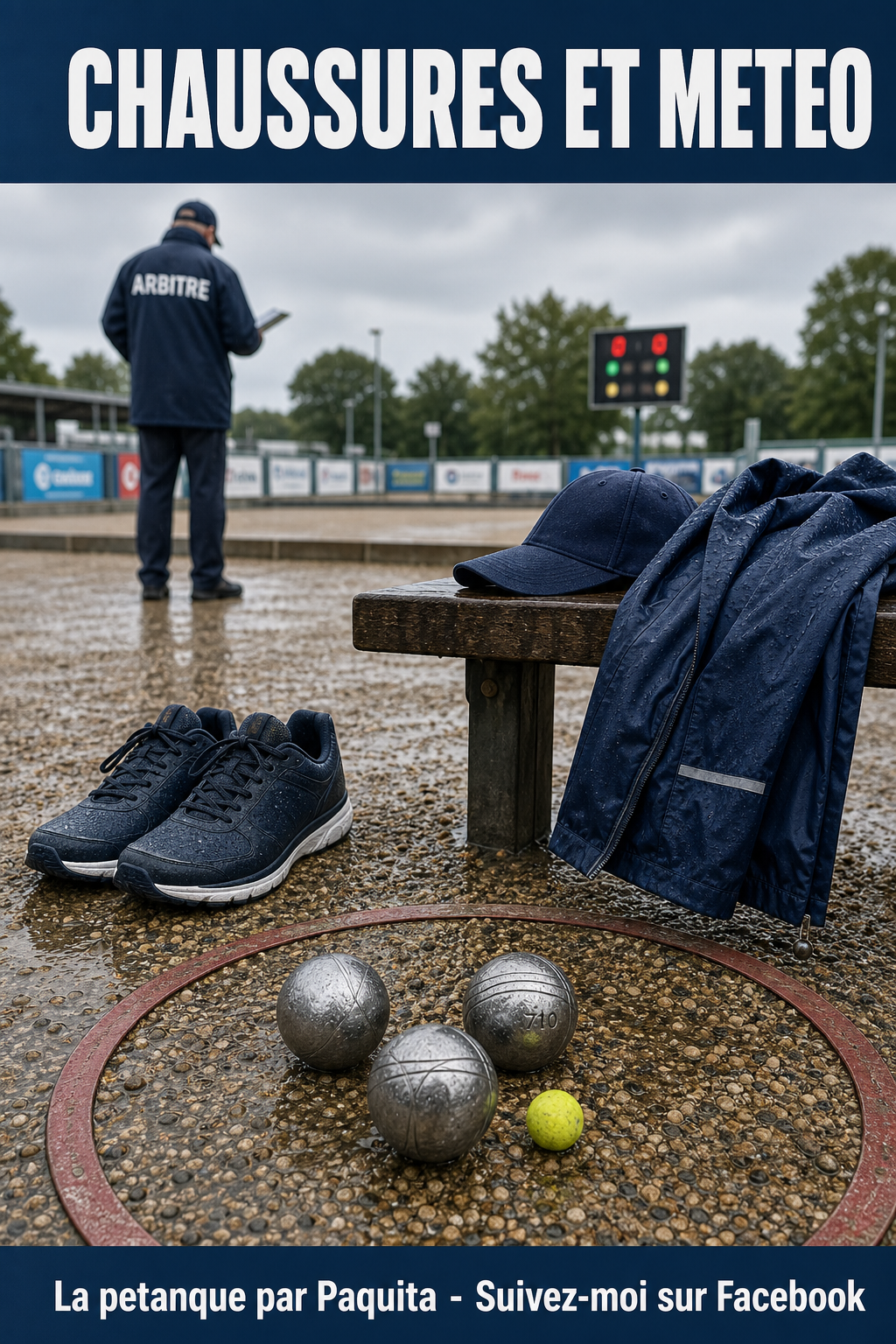
Petanque is played outside, so players encounter rain, heat, wind and sometimes cold. The rules cannot describe every possible combination of cap, jacket, hat, shoe and pants. It is therefore based on a simple idea: the outfit must remain compatible with the practice of sport, the identification of the team and the safety of all.
This is where a lot of disputes arise. A player summons rain to carry anything; an opponent invokes the rules to refuse any adaptation. Both reasonings are excessive. Correct reading consists of accepting reasonable protections while maintaining the essential obligations of the test.
Field reference. A holding decision is settled before the start of the games, with the referee or the table, never in the tension of a decisive match.
2.Shoes: the first subject is safety
On stony, wet or boarded terrain, shoes are not an accessory. It protects the player, prevents slipping and limits accidents when a ball comes quickly. Closed, stable shoes that fit the ground are the safest choice for any official competition.
Sandals, flip-flops or shoes that are too open can pose a problem, not because they would always be named in a prohibited list, but because they expose the foot and give an unsporty image. A referee or organizer can therefore intervene if the outfit presents an obvious risk.
| Prepared player | Improvising player |
|---|---|
| quick check, short discussion | unnecessary litigation risk |
3.Cap, hat, hat: allowed or not?
A head covering is used to protect yourself from the sun, cold or rain. As long as he remains sober, not dangerous and compatible with the team's identification, there is nothing abnormal. The club cap is often even a consistent outfit item.
The limit lies elsewhere: provocative message, annoying object, accessory which deliberately hides the identity or which disturbs the adversary. Good sporting sense counts as much as the letter. A cap against the sun does not have the same nature as a costume.
Risk of litigation depending on the timeBefore departure - 2/10The correction is simple, visible and accepted.During the painting - 7/10The same error can be perceived as a sporting challenge.
4.Rain and jacket: keep identification visible
When the rain comes, the jackets come out. The important point is not to completely disappear the team identification if the event requires club attire. In practice, many organizers tolerate a neutral or common jacket, especially if conditions become difficult.
To avoid litigation, the team must ask before covering its senior official if the phase is strict. This simple question avoids a dispute after the fact. The weather warrants adaptation, not complete improvisation.
| Situation | Good reflex | Mistake to avoid |
|---|---|---|
| Before registration | Read the test instructions | Rely on a club habit |
| At the control | Present clear evidence | Chat without documents |
| If there is any doubt | Call the referee calmly | Challenge the opponent |
| After correction | Keep track simple | Modify without notifying the table |
5.Heat: adapt without transforming the competition
In case of heat, players naturally seek to wear lighter. Sports shorts, cap, towel and hydration become essential. But the outfit must remain correct. An official competition is not a beach, even when the thermometer rises.
The real responsibility also lies with the organization: suitable hours, available water, shaded areas if possible, reminder of instructions. A good fielding decision protects players without creating an advantage or privilege.
Keep the proof simple and the workaround. In competitions, the calmest player is often the one who has anticipated the administrative details before arriving on the field.
6.The simple checklist for players and clubs
Player: take closed shoes, club top, neutral jacket, cap and change of clothing. Club: clearly announce the obligations, plan how to react if the weather changes and give the referee useful information before the departure of the games.
This preparation seems trivial, but it avoids unnecessary arguments. The outfit then becomes what it should be: a competition setting, not the main subject of the game.
PAQUITA TOOL — PetanqueLand competition and mêlée softwareWhen it comes to matters of dress, registration, and organization, the hardest part is keeping information clean. The PetanqueLand software helps clubs manage registrations, teams, groups and tables without hazardous copies. Understand pétanque officiating.
FAQ - Your frequently asked questions
Are closed shoes obligatory?
They are strongly recommended for safety and may be required by the organization depending on the event. Open shoes may be refused if they present a risk.
Can we wear a cap in the championship?
Yes if it remains sober and compatible with the team's outfit. The cap is normal protection against the sun.
Does the rain help hide the club top?
It allows for reasonable adaptation, but the team must retain its identification as much as possible or request validation from the referee.
Can a hat or hood be challenged?
Only if they pose an identification, security or behavior problem. Protecting yourself from the cold is normal.
Who decides in case of doubt about the outfit?
The referee, in connection with the specific regulations and the organization. The decision must be made calmly and as soon as possible.