Actualités · 26 July 2026
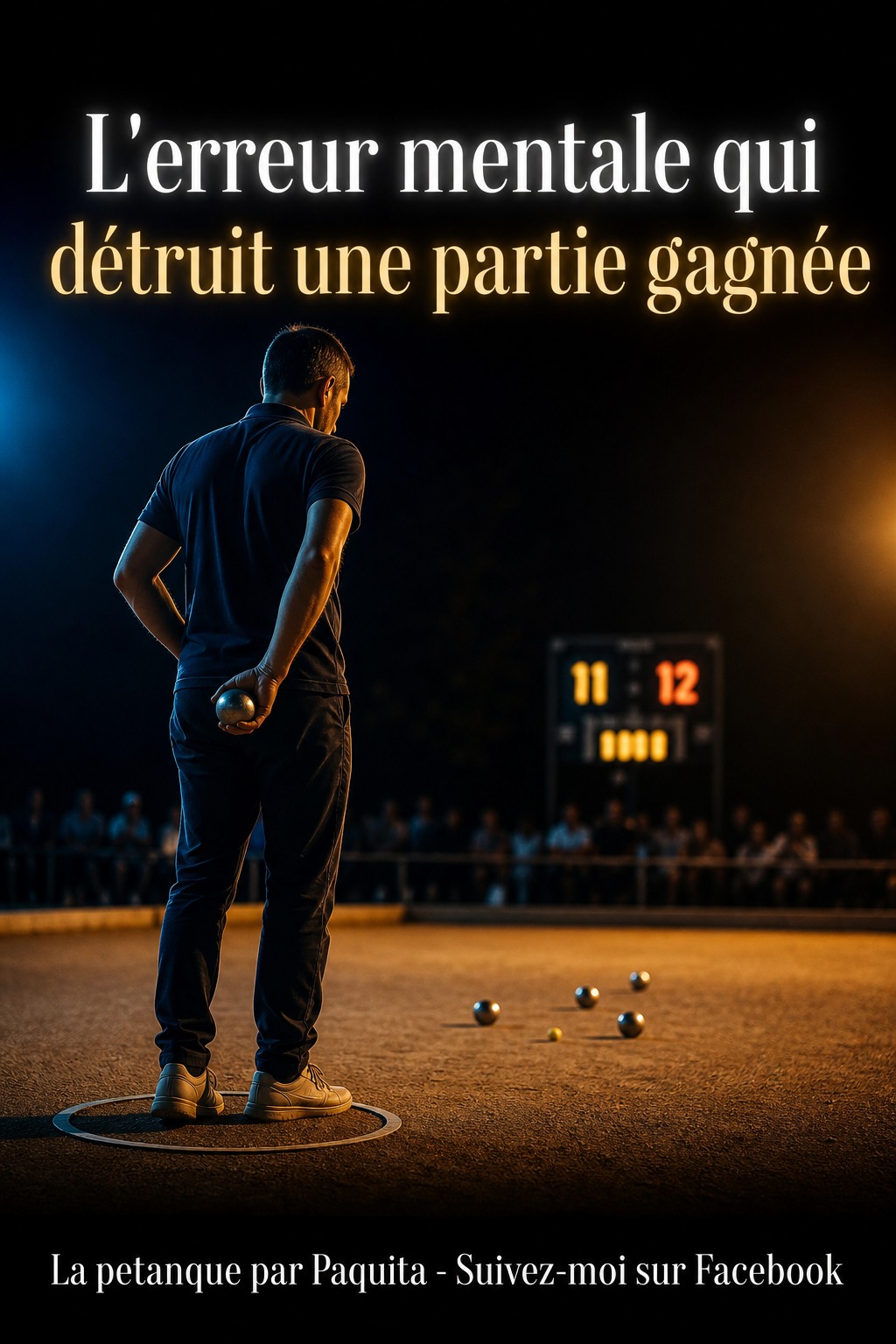
This mental error at pétanque destroyed parts yet won
Playing to avoid losing again modifies the decision, the gesture and the communication when you should remain faithful to your game.01The trap: protect the score instead of playing
When a team leads by a wide margin, it can stop looking for the best move and start avoiding any mistakes. This shift seems prudent, but it reduces engagement, lengthens hesitation and gives the opponent time to regain rhythm. The score then becomes a burden instead of being information.
An expert decision remains verifiable: it takes into account the score, the remaining balls, the terrain and the profile of the players. It does not promise to remove uncertainty; she chooses the most favorable uncertainty. In training, verbalizing this reasoning allows the team to build a common vocabulary and avoid vague debates at the decisive moment.
02How fear modifies gesture
The pointer shortens his pendulum, holds the ball and loses his hand release. The shooter wants to ensure contact, slows down his arm and shoots under the target. These micro-changes are rarely conscious. They are born from a negative internal instruction: above all, do not fail, rather than follow a precise trajectory.
An expert decision remains verifiable: it takes into account the score, the remaining balls, the terrain and the profile of the players. It does not promise to remove uncertainty; she chooses the most favorable uncertainty. In training, verbalizing this reasoning allows the team to build a common vocabulary and avoid vague debates at the decisive moment.
To observe: the value of a ball depends as much on the situation it creates as on its final distance to the goal.
03Communication that accelerates collapse
After two missed balls, the partners can multiply the advice, change their mind or recall the score. Each sentence increases the sense of urgency. Useful communication remains brief: data, intention, prohibited area. It protects attention and prevents the player from carrying the gesture and collective concern at the same time.
An expert decision remains verifiable: it takes into account the score, the remaining balls, the terrain and the profile of the players. It does not promise to remove uncertainty; she chooses the most favorable uncertainty. In training, verbalizing this reasoning allows the team to build a common vocabulary and avoid vague debates at the decisive moment.
04Revert to a Tiny Game Unit
You don't win a game by defending a five-point lead. We play a piece of data, a trajectory and a ball. Strong teams intentionally bring their horizon back to the current task. They check the ground, choose, breathe, execute, then start again without commenting on the overall scenario.
An expert decision remains verifiable: it takes into account the score, the remaining balls, the terrain and the profile of the players. It does not promise to remove uncertainty; she chooses the most favorable uncertainty. In training, verbalizing this reasoning allows the team to build a common vocabulary and avoid vague debates at the decisive moment.
05Choose without becoming passive
Prudence is not the absence of ambition. With a favorable score, we can reduce the variance while remaining offensive: point in a zone which closes the game, shoot a ball which opens several points, or move the stopper towards a controlled space. The right choice reduces danger without giving up initiative.
An expert decision remains verifiable: it takes into account the score, the remaining balls, the terrain and the profile of the players. It does not promise to remove uncertainty; she chooses the most favorable uncertainty. In training, verbalizing this reasoning allows the team to build a common vocabulary and avoid vague debates at the decisive moment.
06An anti-tip routine in competition
After each end, ask three questions: how many balls, what data, what maximum acceptable risk? Add slow breathing and a neutral phrase such as “same game, next ball.” Repeated in training, this routine prevents the brain from transforming an advance into an obligation to achieve results.
An expert decision remains verifiable: it takes into account the score, the remaining balls, the terrain and the profile of the players. It does not promise to remove uncertainty; she chooses the most favorable uncertainty. In training, verbalizing this reasoning allows the team to build a common vocabulary and avoid vague debates at the decisive moment.
| Time | Useful question | Trap |
|---|---|---|
| Before | What are the facts? | Anticipate failure |
| In the circle | What unique intention? | Fix everything |
| After | What did the land do? | Observing |
Banish “we just have to”. Replace it with an observable instruction: height, reach, fall zone or point of impact.
Dig deeper into the game and turn these principles into solid habits.
Discover the guide