Débat · 21 August 2026
Ce que personne n'ose dire sur la jalousie à la pétanque
La jalousie en équipe n’est pas une fatalité : reconnaître les signaux, en parler à froid et retrouver des décisions collectives.Jealousy often appears when a player feels less recognised, less chosen or less useful. Denying it makes it fester; naming it with tact puts the team back at the centre of the game.
1.Jealousy is not a dirty word, but it is costly
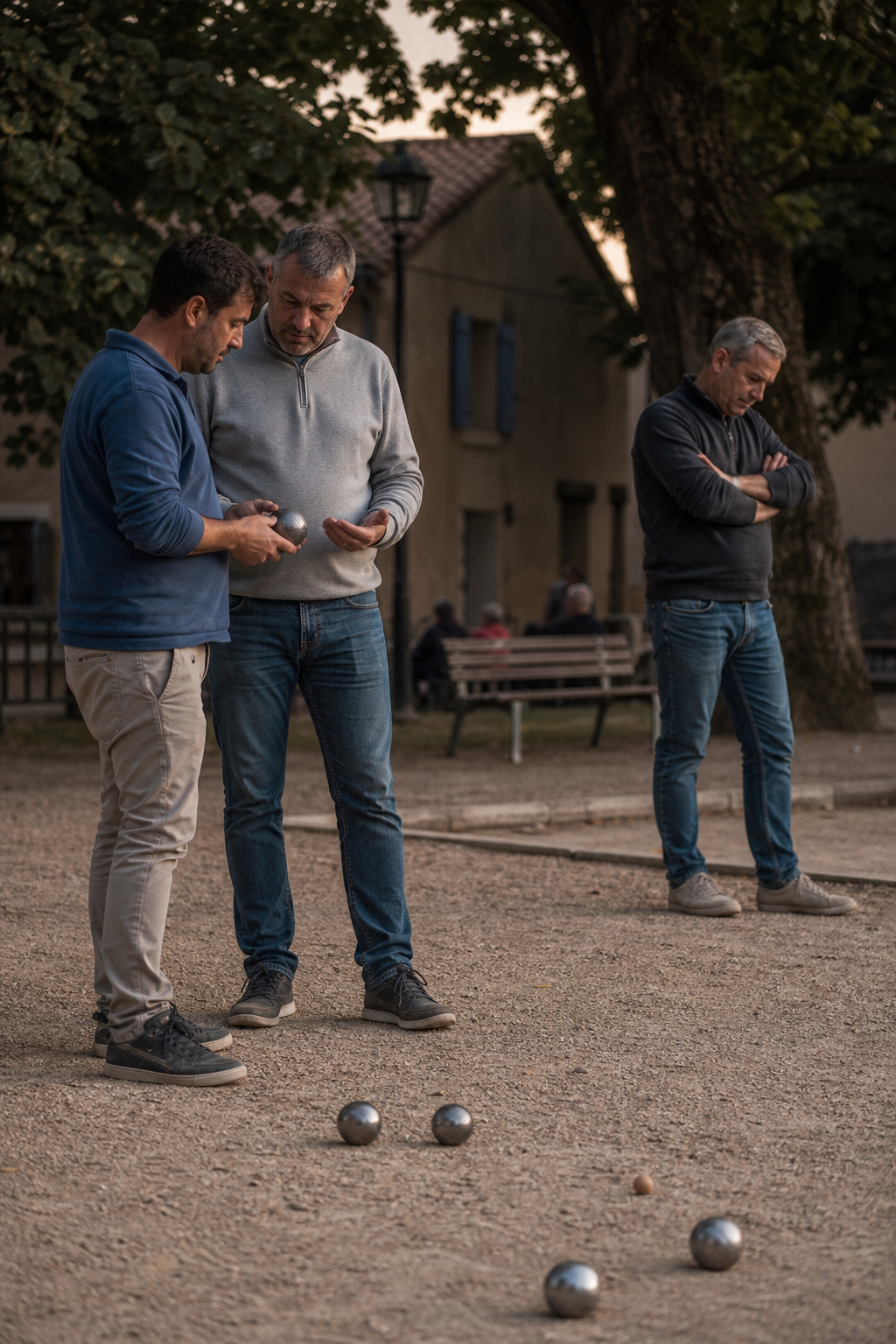
In pétanque, it rarely hides behind a dramatic scene. It more often takes the form of a “Are you shooting again?”, advice said too loudly, or silence after a fine boule. The problem is not the emotion itself: everyone naturally compares their place. The danger comes when comparison becomes a final verdict on one’s worth.
A pointer may feel erased when the shooter receives compliments. A young player may think an older one is taking away their air on the court. Conversely, the person succeeding may tense up, afraid of seeming arrogant. This tension makes useful information disappear: instead of watching the jack, players watch everyone’s status.
A strong team celebrates a boule without turning one person’s success into a judgement on the other two.
2.The triggers are often more concrete than we think
Jealousy grows in unclear areas: who calls the play, who takes the shot, who speaks to the captain, who is featured on posters. When roles are never clarified, every choice looks like a personal preference. A clear role does not freeze a team ; it prevents improvisation from being experienced as exclusion.
Social media sometimes adds its small spark. A photo, a partner mention or a ranking can make it seem as though one person has become “the face” of the triplette. Before reacting in the heat of the moment, check the facts: is someone really being sidelined, or is it wounded pride after a difficult day?
3.During an end, discomfort quickly turns into a bad decision
Imagine a triplette trailing 8–7. The shooter has just missed twice; the pointer has placed an excellent boule. Instead of calmly asking for the solution, a partner says: “Now you can be the hero.” The sentence seems light, but it pushes everyone to play defensively. The revenge boule is almost always a bad boule.
| Observed sign | Useful response | Avoid |
|---|---|---|
| A barb after a success | Return to the game situation | Answer back in front of the opponent |
| A player falls silent | Ask for their opinion before deciding | Interpret their silence |
| A role is challenged | Discuss it again after the game | Settle it through humiliation |
Debriefing in the middle of an end. The right decision is urgent; the right conversation can wait until the game is over.
4.Speak fairly: describe a fact before accusing
An effective discussion begins with a precise situation: “Over the last three ends, you decided without asking for my view; I felt left out of the game.” This wording does not assign an intention. It opens a door. In contrast, “You always look down on me” immediately invites a defence.
The captain does not have to play judge. Their role is to protect a framework: everyone can say what they felt, and no one turns a feeling into a truth about someone else. To establish this reflex, teams can rely on the markers in the Improve path and on a shared tactical reading through pétanque tactics.
5.A small routine to make trust visible
Before a competition, take five minutes to answer three questions: what does each person need to play well; how do we ask for an opinion; what do we do after a mistake? This agreement does not guarantee a peaceful day, but it provides words when tension rises. Trust is prepared before conflict.
After the game, keep a very simple round table: one successful team action, one decision to revisit, one thing to try at the next practice. The aim is not to award marks. It is to remember that three players can be different without becoming rivals. To maintain that shared enjoyment, the Start pétanque guide remains useful even after years of playing.
Frequently asked questionsFrequently asked questions
Does jealousy mean a team is finished?
No. It becomes dangerous when it is never spoken about or when it controls the playing choices.
Should you change partner at the first conflict?
No. First try a precise conversation away from competition, then see whether behaviour changes.
Can you be jealous of a friend?
Yes. Friendship does not prevent comparison; it actually provides a basis for talking about it respectfully.
Who should start the conversation?
The person who feels the discomfort can open it. The captain can help keep the exchange calm and concrete.
Which Paquita advice should I remember?
A team does not need to be equal in everything; it must be fair in the attention it gives everyone.