Actualités · 26 July 2026
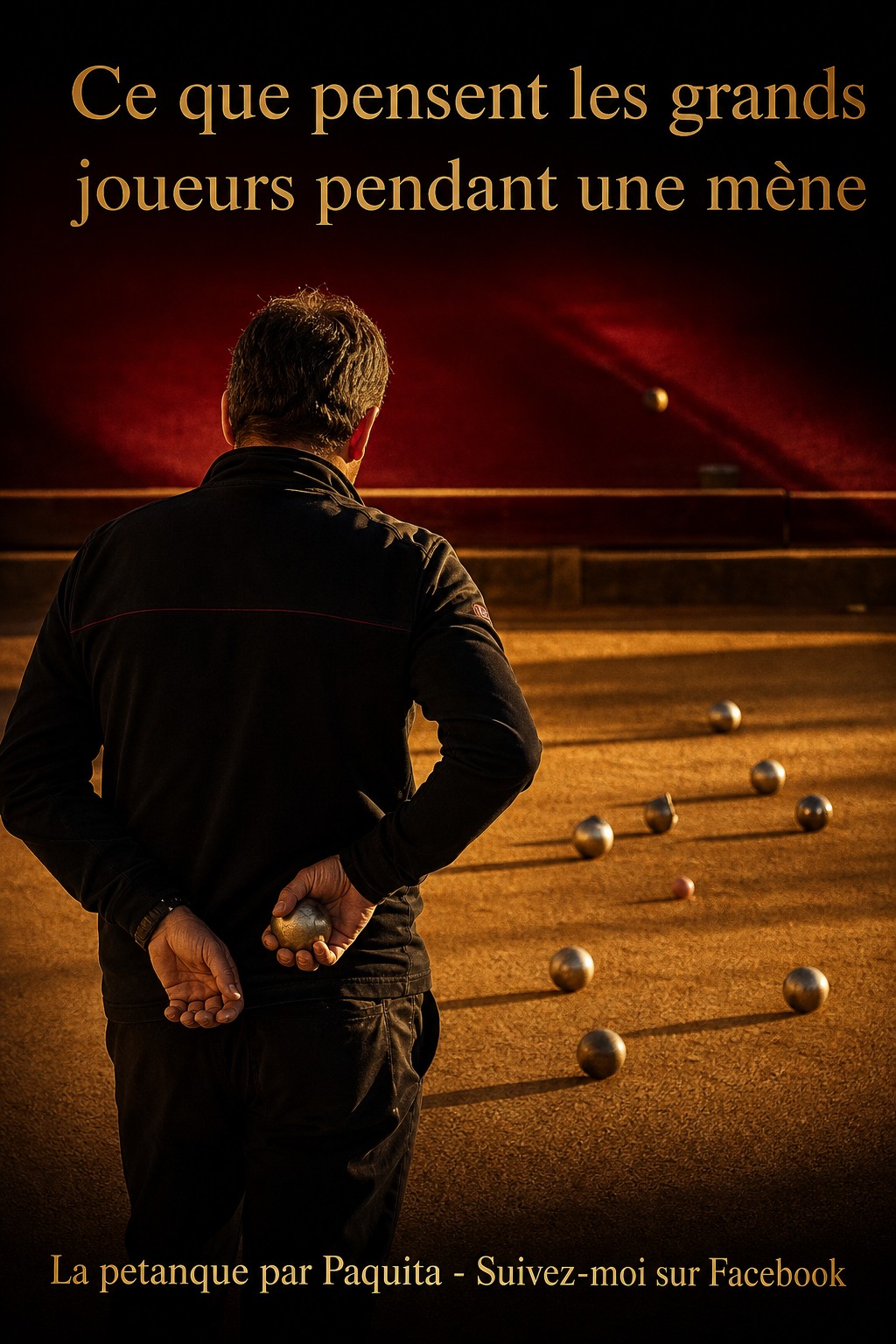
What the great pétanque players think during a session
Their advantage does not come from an empty mind, but from attention organized around simple and directly useful information.01They read the lead as a series of states
A great player does not stay attached to the plan announced at the start. After each ball, it counts again, observes the open paths and updates the risk. This flexibility avoids defending an idea that has become bad. The lead is a living problem whose data changes with each impact.
An expert decision remains verifiable: it takes into account the score, the remaining balls, the terrain and the profile of the players. It does not promise to remove uncertainty; she chooses the most favorable uncertainty. In training, verbalizing this reasoning allows the team to build a common vocabulary and avoid vague debates at the decisive moment.
02They separate observation and decision
First the facts: held point, distances, remaining balls, slopes and obstacles. Then only the choice. Mixing the two pushes you to select information that confirms a preference. By separating the steps, the player more easily accepts an unexpected shot or defensive point.
An expert decision remains verifiable: it takes into account the score, the remaining balls, the terrain and the profile of the players. It does not promise to remove uncertainty; she chooses the most favorable uncertainty. In training, verbalizing this reasoning allows the team to build a common vocabulary and avoid vague debates at the decisive moment.
To observe: the value of a ball depends as much on the situation it creates as on its final distance to the goal.
03They think in short scenarios
Instead of imagining the end of the game, they compare two or three answers: if I succeed, what can the other do; if I miss short, what do we offer him; what result remains playable? This anticipation is limited, concrete and linked to the available balls. She is not an anxious reverie.
An expert decision remains verifiable: it takes into account the score, the remaining balls, the terrain and the profile of the players. It does not promise to remove uncertainty; she chooses the most favorable uncertainty. In training, verbalizing this reasoning allows the team to build a common vocabulary and avoid vague debates at the decisive moment.
04In the circle, they reduce the words
Once the decision is made, the analysis must stop. The player maintains an image of trajectory, a feeling of rhythm or a precise area. Adding a technical correction at the last moment overloads attention. Champions appear calm because they know how to shut down discussion before execution.
An expert decision remains verifiable: it takes into account the score, the remaining balls, the terrain and the profile of the players. It does not promise to remove uncertainty; she chooses the most favorable uncertainty. In training, verbalizing this reasoning allows the team to build a common vocabulary and avoid vague debates at the decisive moment.
05After the ball, they collect information
The emotional reaction is brief. They look at bounce, remaining force and ground response. Even a miss improves the next ball if observed without judgment. This curiosity also protects confidence: the result becomes data, not a definition of the player's level.
An expert decision remains verifiable: it takes into account the score, the remaining balls, the terrain and the profile of the players. It does not promise to remove uncertainty; she chooses the most favorable uncertainty. In training, verbalizing this reasoning allows the team to build a common vocabulary and avoid vague debates at the decisive moment.
06Train a useful thought
Film a lead and stop the image before each throw. Write facts, options, choices and intention. Then compare with the actual decision. The exercise reveals recurring oversights: hidden opposing ball, possibility of moving the goal, or underestimation of a point zone.
An expert decision remains verifiable: it takes into account the score, the remaining balls, the terrain and the profile of the players. It does not promise to remove uncertainty; she chooses the most favorable uncertainty. In training, verbalizing this reasoning allows the team to build a common vocabulary and avoid vague debates at the decisive moment.
| Time | Useful question | Trap |
|---|---|---|
| Before | What are the facts? | Anticipate failure |
| In the circle | What unique intention? | Fix everything |
| After | What did the land do? | Observing |
Before entering the circle, formulate your decision in eight words maximum. If the sentence remains long, the choice is probably not complete.
Dig deeper into the game and turn these principles into solid habits.
Discover the guide