Actualités · 3 April 2026
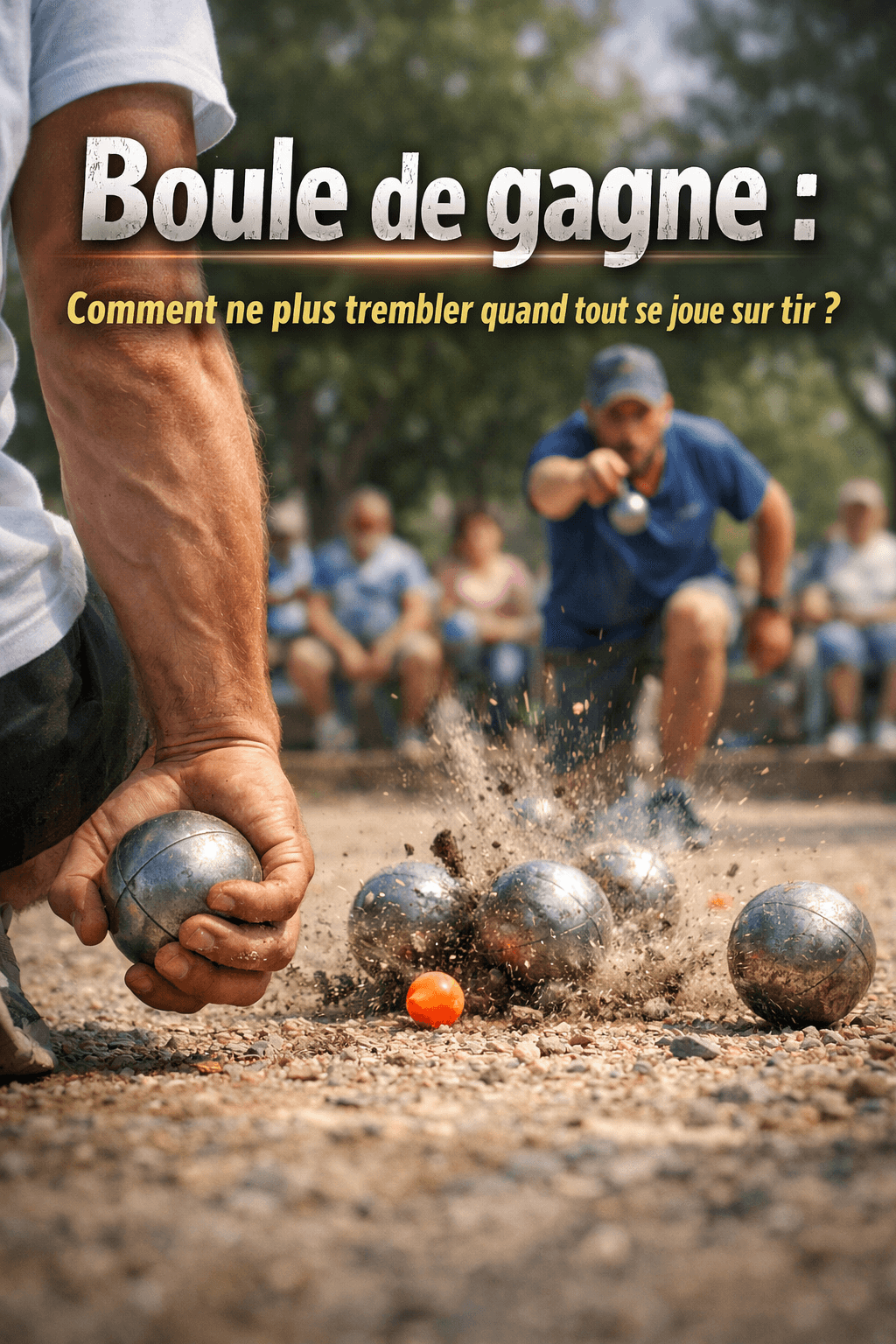
The winning boule: How to stop trembling when everything rides on a shot?
11-10 for you. Last ball. Your teammates are silent. The opponents are waiting. And then, in the 10 seconds before the throw, something happens in your body that you can't control. Your hand squeezes too tightly. Your breath catches. A stray thought sets in: “What if I fail?” This moment exists for everyone — beginners and champions alike. The difference is not in not feeling it. It's knowing what to do with it. 87% of errors in critical situationsWhat happens in the body under pressure
The winning bowl isn't only a technical moment — it's a physiological event. Understanding what happens in the body at that precise moment lets you stop fighting your own biology and instead steer it.
❤️ Heart racingThe heart races. It's not weakness — it's adrenaline, a survival response. The body is getting ready for action.
Impact: tenser muscles, less fluid motion 🫁 Breath heldMany players hold their breath without realising it just before throwing. It's the number-one cause of a tense hand.
Impact: tension in the shoulders, disrupted release 👁️ Tunnel visionThe field of vision narrows. The brain over-focuses on the target or, conversely, scatters onto the spectators and the score.
Impact: unstable aiming point, deflected trajectory ✋ Hand tensing upThe hand grips the bowl too tight. This tension prevents a fine finger release — and it's precisely that release that makes the quality of the shot.
Impact: shifted release point, lost effect 🧠 Intrusive thoughtsThe prefrontal cortex floods the brain with disaster scenarios: the miss, the others' stares, the score, the lost game.
Impact: the motion becomes conscious and therefore degrades ⏱️ Time distortionThe seconds seem to stretch. That felt silence between the decision to throw and the throw itself can trigger catastrophic last-second micro-adjustments.
Impact: change of axis at the last moment 🔬These reactions are normal and universal. Champions feel them too — they've simply learned to recognise them without amplifying them and to immediately trigger a routine that short-circuits the anxiety spiral. It's a skill that can be learned, not a gift.
The 5 toxic thoughts that ruin the winning bowl
Each thought listed below has a measurable physiological effect on the motion. For every toxic thought, its immediate antidote.
💀 TOXIC THOUGHT N°1 "What if I miss?" → Activates the avoidance circuit. The brain visualises the miss — which increases its probability. The hand tenses. → ✓ ANTIDOTE "One shot. My landing point. I shoot." — Bring the brain back to the concrete and the immediate present. 💀 TOXIC THOUGHT N°2 "Everyone's watching." → Triggers excessive self-awareness. The automatic motion becomes conscious — and immediately degrades. → ✓ ANTIDOTE "The crowd is scenery. I only see my landing point." — Label + exclusive focus. 💀 TOXIC THOUGHT N°3 "I should have played better before getting here." → Sinks into the past. The past is paralysing. This thought consumes cognitive resources the motion needs. → ✓ ANTIDOTE "The past no longer exists. Now." — Stop dead and return to the present with your personal keyword. 💀 TOXIC THOUGHT N°4 "This is the most important bowl of my life." → Over-meaning of the stakes. The stronger the perceived stakes, the stronger the physiological response. The bowl becomes an existential trial. → ✓ ANTIDOTE "It's a shot like any other. I've done it a thousand times." — Voluntary desensitisation of the stakes. 💀 TOXIC THOUGHT N°5 "Whatever you do, don't miss." → The brain doesn't process negation. "Don't miss" = "miss". This phrasing mentally activates the image of the miss. → ✓ ANTIDOTE "I'm aiming at this precise point. I shoot." — Positive, concrete phrasing focused on the desired action. 🎙️ Paquita on intrusive thoughts "The worst enemy on a winning bowl isn't the opponent. It's the voice in your head doing live commentary on your own game. That voice doesn't disappear with experience — it changes register. With beginners it says 'you're going to miss'. With seasoned players it says 'you should have played differently'. With champions it whispers 'maybe not quite the right trajectory'. The solution isn't to silence it — it's to cut its mic with a routine. A routine keeps the brain busy enough that the voice has no room." — PaquitaThe RSC protocol — the 5-step pre-shot routine (12 seconds)
The RSC (Standard Concentration Routine) is the structured response to pressure. It doesn't eliminate adrenaline — it channels it. Executed systematically, it becomes a conditioned switch: as soon as you start the routine, your brain goes into "shoot" mode, not "panic" mode.
RSC PROTOCOL Standard Concentration Routine ⏱️ 12 seconds 1 Stable feet — physical grounding Feel the ground under your feet. Press consciously into both feet for 2 seconds. This physical grounding breaks the mental spiral and brings attention back into the body, not into your thoughts. Don't look at the target yet. 2 seconds 2 3/6 breathing — physiological regulation Breathe in through your nose, counting 3 beats. Breathe out slowly through your mouth, counting 6 beats. Once is enough. This long exhalation activates the parasympathetic nervous system — the one that calms. It's not a relaxation technique for meditation, it's pure biology. Deliberately relax your hand on the bowl during the exhalation. 6 seconds Internal script: "I relax my hand. I breathe." 3 Single point — visual focus Fix one single precise point — not the whole jack, not the general area, not the opponent's bowls. One point. A mark on the ground, a pebble, a precise spot you've decided is your landing point. Your gaze doesn't move anymore. Don't look at anything else. 2 seconds Internal script: "I see this point. This point only." 4 Mental script — locking in the intention Say your trigger phrase inwardly. It must be short, positive, in the present imperative. Not a description of the desired result — an action instruction. This script is personal: you choose it and train with it until it automatically triggers the desired state. 1 second Examples: "Routine. Point. Shoot." — "There. Now." — "My motion. My point." 5 Commitment — throw without pulling back Once the script is said, throw within 2 seconds — no more. Any hesitation after commitment is an invitation to intrusive thoughts. The throw is the natural continuation of the script. No last-second adjustment. If you feel the need to stop, restart the routine from step 2 — never throw in doubt. 1 second Absolute rule: after the script, the throw follows. No delay, no hesitation. 🔁 The secret of the routine — unconditional repetitionThe RSC only works if it's used on every shot — not only on important bowls. If you only apply it in pressure moments, your brain associates it with pressure and it itself becomes a stress signal. Apply it on routine shots, in training, in friendly games. After 200 repetitions, the routine becomes an automatic switch: you start step 1, and your mental state changes.
4 critical situations and how to handle them
🎯 11-10 — Last bowl, you're leading It's the hardest situation because you have something to lose. The perceived stakes are at their maximum. The classic trap: rushing to "get it over with" or, conversely, overthinking and over-analysing the situation. The brain catastrophises the probable loss rather than focusing on the available action. → Full RSC mandatory. Script: "One shot. My point. I shoot now." No glance at the score before throwing. ⚖️ 10-10 — The decisive end, scores level Here the problem isn't the fear of losing — it's the acute awareness of the balance. Every bowl carries the same potential weight. This thought can paralyse or generate over-caution that degrades your natural play. Some players curiously play better at 10-10 than at 11-10 because the pressure is "symmetric". → Treat this shot exactly like any other. Script: "It's an ordinary shot. I play my game." 😤 After a miss — the next bowl The bowl that follows an important miss is statistically harder than the bowl before. The anger, shame or frustration of the miss creep into the next motion. Many players throw the next bowl still under the emotional grip of the previous miss — without realising it. → Mandatory RAE protocol before any next bowl: STOP → breathe → neutral → back to RSC. Minimum 15 seconds between the miss and the next throw. 👥 Team pressure — "Just point one there" Well-meaning teammates can be the worst disruptors. A last-second piece of advice, an expectant look, a "come on" breathed during the swing — all of this enters the routine and short-circuits it. Social pressure is sometimes more destructive than score pressure. → Establish a clear team rule: complete silence as soon as a player enters their routine. Communicate tactically before on positioning, never during.Before, during, after the decisive shot
⏳ BEFORE — Prepare- Tactical decision made with the team
- Choose your precise landing point
- Take a step back before entering the circle
- 3/6 breathing even before approaching
- Recall a recent proof of success
- Mentally block out the environment
- Full RSC in 5 steps
- Feet — Breathe — Point — Script — Shoot
- Eyes on the landing point until the end of the follow-through
- Full hand follow-through — don't lock it
- No adjustment after the script
- Decision locked in — total commitment
- Success: celebrate with restraint, stay in the game
- Miss: immediate STOP of any negative thought
- RAE protocol if the next bowl is close
- Note 1 positive fact observed in the session
- Never a hot technical analysis after a miss
- Recovery = an integral part of performance
What to say / what never to say to your team
The words you say to your teammate before their winning bowl have a direct impact on their mental state. Here are the 7 most common situations.
| ❌ What we often say (and it destroys) | ✓ What to say instead |
|---|---|
| "Whatever you do, don't miss, we need this point." | "Your motion. Your point. We trust you." — then silence. |
| "Just do that, it's simple." | Nothing. Silence is often the best support. |
| "Come on, come on!" during the swing. | Wait until the bowl has left. Always. |
| "Ah, too bad..." immediately after a miss. | "No worries, we reset." — then move on without dwelling. |
| "Are you playing there or still thinking?" | Leave the player in their routine. Don't comment on their pace. |
| "We're useless today" at 10-11. | "We still have a bowl. Let's focus on this one." |
| "It's like the last time you missed." | Never refer to past misses. Never. |
"Whatever you do, don't miss." — This phrasing is doubly toxic. It mentally activates the image of the miss (the brain doesn't process "don't"). And it turns the action into a negative obligation rather than an opportunity. If you have nothing useful to say before a teammate's winning bowl, silence is infinitely better.
Train for pressure — not just for technique
The technique acquired in calm training disappears in tournaments if the mental component hasn't been trained under similar conditions. Here's how to build pressure into your training.
- 🎯The restart rule: during training, set yourself a goal — e.g. 3 consecutive bowls in the zone. If you miss, start over from zero. This constraint creates simulated pressure that activates the same mechanisms as an 11-10 in a tournament.
- 🧠Apply the RSC on every throw without exception: not only on "important" shots. Every bowl, even in solo training, deserves the full routine. After 500 repetitions, it becomes automatic under pressure.
- 📊Give yourself a "pressure score": after each session, rate from 1 to 10 your perceived mental stability. Not your technical level — your calm. Tracking this indicator separately from the technical score often reveals that the two don't progress together.
- 👥Simulate the gaze: ask someone to watch you silently while you throw a simulated decisive bowl. The mere presence of a gaze changes your mental state — and that's exactly what you need to learn to manage.
- 🔄Train the RESET: deliberately miss a bowl (or imagine it), then time how long it takes you to regain a neutral state before the next bowl. The goal: under 15 seconds of emotional recovery.
Paquita's book devotes an entire part to the competitive mental game: pre-shot routine, managing 12-12, emotional stabilisation, RAE, 12SM, PDX protocols... with 6 printable worksheets included free.
📦 Order on AmazonFAQ — Your frequent questions
Does the anxiety over a winning ball disappear with experience? + Partially, but not as we think. Physiological anxiety (heart rate, breathing) does not disappear — it decreases slightly with experience but remains present even in very good players. What changes with experience is the relationship with that anxiety : the experienced player recognizes it, accepts it as normal and activates his routine without resisting it. The beginner endures it and tries to fight it — which amplifies it. The good news: this relationship to anxiety is learned much faster than the technical level of play. My teammate always gets stuck on important balls. How to help him? + The first thing to do is never report the problem during the game — it will make the situation worse. Between games or during training, talk to him about RSC without presenting it as a solution to "his problem" but as a technique that you also use. Suggest that they practice it together. The second thing: absolutely respect his silence before the shot — don't stare at him, don't give him any last-second advice. The expectant look of a teammate can be enough to trigger the block. I play better in training than in competitions. For what ? + This is the most common problem — and the most frustrating. It has an almost systematic cause: your technical gesture is acquired, but not your gesture under pressure. In training, you play in a calm physiological state. In competition, your body enters a different state and your gesture, which was only repeated in the calm state, deteriorates. The solution is to integrate pressure into training (see the dedicated section) and to use RSC in training as often as in competition, so that the gesture is conditioned to work in both states. How long does it take for a pre-shot routine to become automatic? + Between 3 and 6 weeks of regular practice — provided you apply it to every shot without exception, not just for important shots. We are talking about 200 to 400 minimum repetitions for the routine to begin to activate reflexively. The progression is non-linear: the first two weeks, the routine seems artificial and even slows down the game. Between the third and fifth weeks, it begins to become more fluid. Beyond that, it becomes the automatic signal for entry into a state of concentration. And if I missed the winning ball — how do I mentally recover for the rest of the game or competition? + The RAE (Error Recovery) protocol in 4 steps: STOP — physically and mentally stop any thought about the miss; Breathe — a long exhalation (3/6) to regulate; Neutral — return to a flat emotional state, neither positive nor negative, just present; RSC — resume the standard routine for the next bowl. The absolute rule: never analyse a miss technically while still hot. Analysis comes after the game, in the proof log, never during the tournament. During the tournament, the only useful question is "what do I do now?" — never "why did I miss?" 📎 Related articles Equipment Top 3 best shooter boules 2026 Equipment Stainless steel vs carbon — what impact on your game? Rules The one-minute rule — managing time under pressure Competition Officials in pétanque — referees and roles Video Umpiring videos — game situations with commentary Tools Free PetanqueLand tools© Pétanque by Paquita — petanqueland.fr · 📖 Paquita's book on Amazon