Règlement FFPJP · 27 July 2026
Petanque benefit of the doubt rule: myth or official reality?
Does the benefit of the doubt really exist in petanque? Here is how FFPJP rules handle measurements, disputes and referee decisions.1.What players call benefit of the doubt
In common parlance, benefit of the doubt means that an uncertain situation should benefit someone. On a petanque court, this idea appears especially when two balls appear to be equal distance from the goal, when a jack seems limited or when a ball touches a loss line. The problem is that the rules don't work on a printout. It requires establishing the facts of the game.
The nuance is important: doubt can trigger a check, but it is not enough to award the point. Saying "we leave him in doubt" can be acceptable in a free game, between friends, if everyone agrees. In official competitions, this formula does not replace either the measurement or the intervention of the referee.
Remember this sentence: doubt opens a procedure, it does not automatically result in a decision.
2.Why measurement comes before interpretation
The regulation favors objective elements. For a distance, we measure. For borderline terrain, we check the line. For a moved ball, we establish whether it was marked and who touched it. This logic prevents the game from becoming a succession of negotiations.
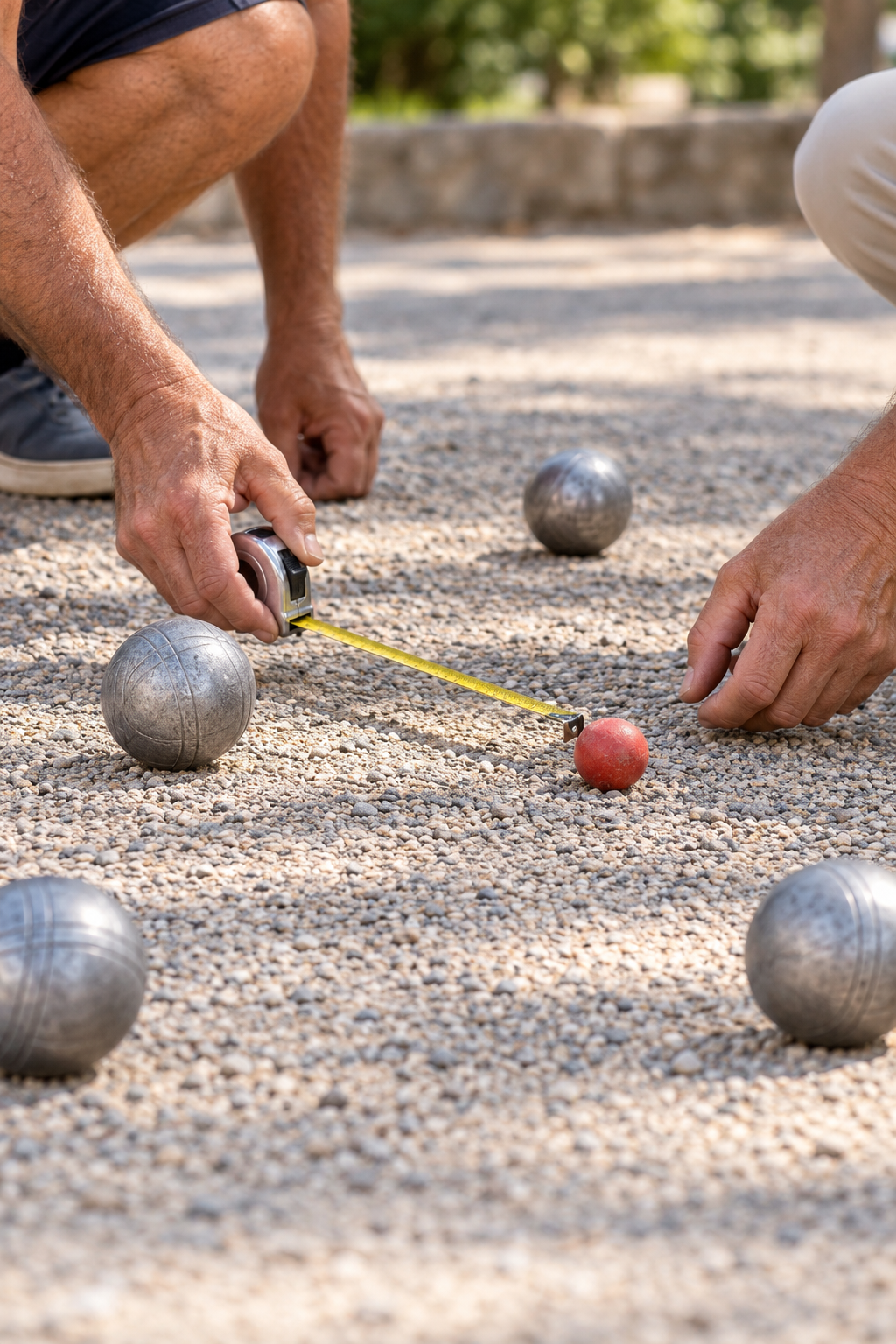
The measurement must be done properly: without moving the balls, with a suitable tool, letting the opponents see the operation. If one team contests the measurement of the other, the referee must intervene. The player who refuses this step takes the risk of transforming a technical question into a behavioral conflict.
3.Equal distance: the most misunderstood case
When two balls are exactly equal distance from the goal, we do not invent a moral priority. The regulations provide solutions depending on the context of the match: if both teams still have balls, the team that played last plays again; if only one team has balls, it continues; if no more balls are available, the end may be zero. The key point is that equality is observed after measurement, not by feeling.
Many discussions arise because a player confuses "I don't see the difference" and "the balls are equal". It's not the same thing. A measurement may reveal a tiny difference but sufficient to identify the point.
| Situation | Good reflex | Mistake to avoid |
|---|---|---|
| Disputed distance | Measure | Make a decision by eye |
| Limit goal | Check validity | Replay too quickly |
| Order of play | Identify the point | Play out of habit |
4.The role of the referee when doubt persists
In competitions, the referee is not called to agree with the most convincing player. He intervenes to apply the rules and secure the rest of the game. His authority is particularly useful when the discussion begins to move beyond the technical field: rising tone, contradictory witnesses, players who want to take a ball back before the decision.
Calling on the referee is not an admission of weakness. It is the right tool when a situation can no longer be resolved calmly by the players. The sooner the call is made, the simpler the decision.
When you feel that everyone has been repeating the same sentence for thirty seconds, stop the discussion and ask the referee. You save time and protect the atmosphere of the game.
5.What to avoid in official competitions
The worst reflex is to play the next ball while doubt still exists. Once a new ball is played, the initial situation becomes more difficult to reconstruct. Another common mistake: moving a ball "to measure better" without clear agreement. If the balls are not marked, the dispute may become insoluble.
Good practice is simple: we stop, we look, we measure, then we start again. This discipline seems slow, but it avoids minutes of contestation later.
6.The right formula to remember
There is no automatic benefit of the doubt in petanque. There are facts of the game to be established and a procedure to be followed. In free play, players can always make arrangements. In competitions, the amicable agreement must never contradict the regulations nor penalize a team which requests normal verification.
The solid player is not the one who wins all the discussions, but the one who knows how to bring the game back to objective elements. It is this rigor that makes the difference in close encounters.
To progress in reading the game, strategy and competition routines, the complete series brings together the technical and mental bases useful to club players.
Discover